Hippasteria muscipula
From Wikipedia, the free encyclopedia
| Hippasteria muscipula | |
|---|---|
 | |
| Hippasteria muscipula holotype | |
Scientific classification  | |
| Domain: | Eukaryota |
| Kingdom: | Animalia |
| Phylum: | Echinodermata |
| Class: | Asteroidea |
| Order: | Valvatida |
| Family: | Goniasteridae |
| Genus: | Hippasteria |
| Species: | H. muscipula |
| Binomial name | |
| Hippasteria muscipula Mah, Neill, Eleaume & Foltz 2014[1] | |
Hippasteria muscipula is one of twelve species of deep-sea sea star in the genus Hippasteria, which is in the family Goniasteridae.[1]
It is a regular, five-armed sea star, with a large and flattened central disc (as most species in this family). The body is covered by short and stout spines, and characterized by big, fly-trap like pedicellariae. When alive, the central disc is swollen, forming five radial bumps.[2] It is a rather big species, and can grow up to 30 cm across.[3]
This species seems to be a predator of deep sea coral and other cnidarians, and was observed climbing on corals in order to feed.[2][4]
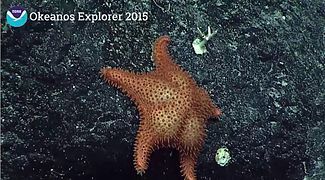 Hippasteria muscipula observed in the deep sea off Hawaii
 Hippasteria muscipula climbing on coral, probably feeding (with yellow polychaete worms).


This species remained unknown to science until 2014,[5] but since its description it was observed many times in its environment by deep-sea research missions, such as Okeanos Explorer 2015, off Hawaii.[2]
Its name comes from its impressive pedicellariae, which look like traps of the carnivorous plant called "Venus fly trap" (Dionaea muscipula).[3]