Hjalmar Munsterhjelm
Finnish painter (1840–1905)
From Wikipedia, the free encyclopedia
Magnus Hjalmar Munsterhjelm (19 October 1840 – 2 April 1905) was a Finnish landscape painter. [2]

Hjalmar Munsterhjelm | |
|---|---|
 Munsterhjelm in 1871–1878 | |
| Born | 19 October 1840 |
| Died | 2 April 1905 (aged 64) Helsinki, Grand Duchy of Finland |
| Education | Member Academy of Arts (1874)[1] |
| Known for | Painting |
| Style | Classicism |
| Movement | Realism |
Biography
Munsterhjelm was born at Toivoniemi Manor of Tuulos, Finland. He was the son of Gustaf Riggert Munsterhjelm (1806-1872) and his wife and Mathilda Charlotta Eleonora von Essen (1818-1895). His father first sent him to the Turku Maritime School. In the early 1860s, he studied art at Düsseldorf with Werner Holmberg (1830-1860) and Oswald Achenbach (1827-1905) and at Karlsruhe under Hans Gude.[3][4]

His painted landscapes were influenced by the romanticism of the Düsseldorf school, often featuring nature as a mood rather than a realistic subject. His landscape "October Evening After the First Snowfall" (1883) was purchased by Alexander III in 1885; the painting is now in the Ateneum in Helsinki.[5][2] Two of his works, "The Evening, in Finland" and "The Night" were displayed at the 1878 Paris Exposition.[6] His work "Evening of the First Spring" was also on display at the 1900 Paris Exposition.[7][2]


He married Olga Mathilda Tanninen (1856–1929) in 1875. They had four children, one of whom was the sculptor John Munsterhjelm (1879–1925). Munsterhjelm became a member of the Royal Swedish Academy of Fine Arts in 1897.[8]
He kept being highly productive all the way until his death in 1905 in Helsinki.[9][2]
In current times his moonlight paintings are some his most famous and popular.[10][11]
Works
 Shepherd in the Alps, 1860
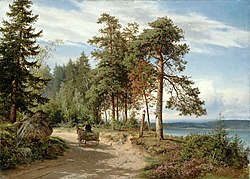 Road in Finland, 1865
 Peasant Woman from Bayern, 1860s
 Birches in Summer, 1869
 Village Street in Schwartzwald, 1870
 Landscape from Hohenaschau, 1871
 Häme Castle, 1872
 Winter Landscape from Tuulos, 1874
 Olavinlinna (Winter), 1870s
 Moonlight in Barösund, late 1870s
 Moonlit Night, 1883
 October Evening After the First Snowfall, 1883
 Morning Atmosphere (Island View), 1884
 Moonlight, 1885
 Crack Willows, 1897


.jpg)


_-_A_II_845_-_Finnish_National_Gallery.jpg)
.jpg)
