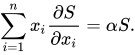
A complete classification of homogeneous distributions in one dimension is possible. The homogeneous distributions on R \ {0} are given by various power functions. In addition to the power functions, homogeneous distributions on R include the Dirac delta function and its derivatives.
The Dirac delta function is homogeneous of degree −1. Intuitively,

by making a change of variables y = tx in the "integral". Moreover, the kth weak derivative of the delta function δ(k) is homogeneous of degree −k−1. These distributions all have support consisting only of the origin: when localized over R \ {0}, these distributions are all identically zero.
In one dimension, the function

is locally integrable on R \ {0}, and thus defines a distribution. The distribution is homogeneous of degree α. Similarly  and
and 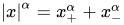 are homogeneous distributions of degree α.
However, each of these distributions is only locally integrable on all of R provided Re(α) > −1. But although the function  naively defined by the above formula fails to be locally integrable for Re α ≤ −1, the mapping

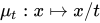
is a holomorphic function from the right half-plane to the topological vector space of tempered distributions. It admits a unique meromorphic extension with simple poles at each negative integer α = −1, −2, .... The resulting extension is homogeneous of degree α, provided α is not a negative integer, since on the one hand the relation
![{\displaystyle x_{+}^{\alpha }[\varphi \circ \mu _{t}]=t^{\alpha +1}x_{+}^{\alpha }[\varphi ]}](https://wikimedia.org/api/rest_v1/media/math/render/svg/def2d21dca77863dbbabcb7b4b9c3d5558aab999)
holds and is holomorphic in α > 0. On the other hand, both sides extend meromorphically in α, and so remain equal throughout the domain of definition.
Throughout the domain of definition, xα
+ also satisfies the following properties:
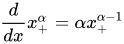

There are several distinct ways to extend the definition of power functions to homogeneous distributions on R at the negative integers.
- χα
+
The poles in xα
+ at the negative integers can be removed by renormalizing. Put
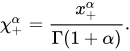
This is an entire function of α. At the negative integers,
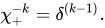
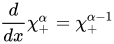
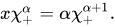
The distributions  have the properties

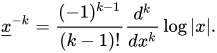
A second approach is to define the distribution  , for k = 1, 2, ...,
These clearly retain the original properties of power functions:
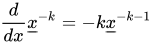

These distributions are also characterized by their action on test functions

and so generalize the Cauchy principal value distribution of 1/x that arises in the Hilbert transform.
- (x ± i0)α
Another homogeneous distribution is given by the distributional limit

That is, acting on test functions
![{\displaystyle (x+i0)^{\alpha }[\varphi ]=\lim _{\epsilon \downarrow 0}\int _{\mathbb {R} }(x+i\epsilon )^{\alpha }\varphi (x)\,dx.}](https://wikimedia.org/api/rest_v1/media/math/render/svg/cf046124ddfa6e14836e32d8dfde6227a921ece5)
The branch of the logarithm is chosen to be single-valued in the upper half-plane and to agree with the natural log along the positive real axis. As the limit of entire functions, (x + i0)α[φ] is an entire function of α. Similarly,

is also a well-defined distribution for all α
When Re α > 0,

which then holds by analytic continuation whenever α is not a negative integer. By the permanence of functional relations,

At the negative integers, the identity holds (at the level of distributions on R \ {0})

and the singularities cancel to give a well-defined distribution on R. The average of the two distributions agrees with :

The difference of the two distributions is a multiple of the delta function:

which is known as the Plemelj jump relation.
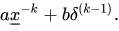
The following classification theorem holds (Gel'fand & Shilov 1966, §3.11). Let S be a distribution homogeneous of degree α on R \ {0}. Then  for some constants a, b. Any distribution S on R homogeneous of degree α ≠ −1, −2, ... is of this form as well. As a result, every homogeneous distribution of degree α ≠ −1, −2, ... on R \ {0} extends to R.
Finally, homogeneous distributions of degree −k, a negative integer, on R are all of the form:

![{\displaystyle S[t^{-n}\varphi \circ \mu _{t}]=t^{m}S[\varphi ]}](https://wikimedia.org/api/rest_v1/media/math/render/svg/95058d7188436cbd38e82e050693bbda73a7b6d5)