House of Rougé
From Wikipedia, the free encyclopedia

The Rougé family is a family of the French nobility from Anjou known since 1045 and that has a traced proven lineage since the year 1375.[1][2]
Most historians believe that the exiting Rougé family from Anjou comes from the medieval Rougé family known since 1045, ruling over the lordship of Rougé in Brittany, a line of the princes of Brittany,[3] but the link between the des Rues family and the former de Rougé family is not yet clearly proven, even though highly possible.[2][1]
Many members of this family have distinguished themselves as generals, churchmen, diplomats, and academics.
The existing des Rues family used the name de Rougé at the beginning of the 16th century after that the older family of the same name de Rougé (known since 1045 became extinct.[2][1]
The proven filiation of the existing de Rougé family is established with Huet des Rues, married in 1375 with Jeanne d'Erbrée[2] or with Jean II des Rues, married in 1421 with Jeanne d’Orvaux.[1]
Most historians believe that exiting Rougé family comes from a Rougé family known since 1045, ruling over the lordship of Rougé in Brittany, but the link between the des Rues family and the former de Rougé family is not proven, even though highly possible.[2][1]
Pierre des Rues, who was confirmed noble in 1667 with proof dating back to 1530, was at the origin of two branches.[2][1]
Notable family members
- Jacques de Rougé du Plessis-Bellière (1602–1654), marquis du Plessis-Bellière, French general, killed in action in Torre Annunziata/Castellammare di Stabia, near Naples in a cavalry charge,
- Pierre François de Rougé (1702–1761), marquis of Rougé, French general, killed in action in the battle of Villinghausen, Germany,
- Gabriel-Louis de Rougé (1729–1772), abbot, vicar-general and bishop of Périgueux (1772).
- Bonabes Jean Catherine Alexis de Rougé (1751–1783), French colonel who fought in the American Revolutionary War, and died at sea in 1783,
- his wife Natalie Victurnienne, Marchioness of Rougé (1759–1828), friend of Queen Marie-Antoinette,
- Bonabes VI Louis Victurnien Alexis de Rougé (1778–1839), marquis de Rougé, Peer of France in 1815,
- Adrien de Rougé (1782–1838), comte de Rougé, Member of the Assemblée Nationale, and then Peer of France in 1827,
Plessis-Bellière elder branch extinct in 1794 :
- Jacques de Rougé du Plessis-Bellière (1602–1654), French general
- Catherine de Rougé du Plessis-Bellière (1707–1794), duchess of Elbeuf, princess of Lorraine, after her marriage in 1747 with Emmanuel Maurice prince of Lorraine, duke of Elbeuf.
cadet branch :
- Emmanuel de Rougé (1811–1872), Egyptologist, Professor at the Collège de France,
- Alain de Rougé (1871–1936), Member of the Assemblée Nationale,
- Arthur de Rougé (1844–1913), count of Rougé, Spanish duke of Caylus and Grandee of Spain in 1893 (by inheritance of the family Robert de Lignerac). He had no son and the title of duke of Caylus in Spain to the Dampierre family.[2]
- Olivier de Rougé, vicomte de Rougé, senator, founder of the cattle breed "Maine-Anjou" (now Rouge des Près),
- Bonabes, Count of Rougé (1891–1975), Secretary General of the Red Cross from 1936 to 1957.
Portrait Gallery
 Jacques de Rougé, marquis du Plessis-Bellière
 François-Henri de Rougé, marquis du Plessis-Bellière, French general
 Pierre-François de Rougé, marquis de Rougé, killed in action in Germany in 1761
 Julie de Coëtmen, marquise de Rougé
 Marie-Thérèse d'Albert d'Ailly, marquise du Plessis-Bellière, by Carmontelle
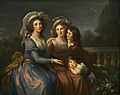 Natalie Victurnienne de Mortemart, marquise de Rougé, by Vigée-Lebrun
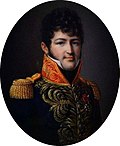 Bonabes Alexis de Rougé, marquis de Rougé and Peer of France
 Alexandrine Thimarette de Crussol d'Uzès, marquise de Rougé
 Count François-Pierre-Olivier de Rougé, French General
 Count Hervé de Rougé
 Emmanuel de Rougé, Egyptologist
 Robert de Rougé, officer and artist
 Count Bertrand de Rougé, killed in action in 1918
 Count Arthur de Rougé, Spanish duke of Caylus, Baillif-grand-Cross of the Order of Malta
 Adolphe de Rougé, by Gomien

.jpg)


.jpg)

.jpg)


.jpg)
.jpg)
Lordships held by the de Rougé family
Les Rues, Le Plessis-Bellière, Chenillé-Changé, La Guerche (Anjou), Moreuil, Villers-aux-Érables, Guyencourt, Faÿ-lès-Nemours, Courtimont, Le Plessis-Courtimont, Roisson, Les Touches, Le Theil-de-Bretagne, Le Teilleul, La Mauvesière, Le Bignon, Sainte Scolace, Vauregnoust, Lorière, Marigné, Le Plessis-Gaudin, La Bellière, Le Bois, La Cour-du-Bois, Maigné, Chigné, Les Mortiers, Dissé, La Courtaillé, La Gauberdière, Les Feuges, Launay, Le Bouays, La Chapelle-Glain, Neuville, La Roche d'Iré, Cinq-Mars-la-Pile, Rouaibile, La Cornouaille, Pontcallec, Gastines, Valençon, Saint-Pierre-Montlimart, La Frébaudière, Langeron, Le May, Montfaucon, Vienne-le-Château, Cholet, Chemillé, Le Tremblay, La Cour de La Raye, Rostrenen, Kerjean, Hervillé, Moyencourt, Hardecourt-aux-bois, La Maison-Rouge, etc.[citation needed]
Castles held by the de Rougé family
Bois-Dauphin à Précigné, Sablé-sur-Sarthe, Moreuil, Guyencourt-sur-Noye, Villers-aux-Érables, Coetmen, in Tréméven, Tonquédec, chateau de Baronville, Dinteville, La Maison-Rouge, Mesnil-Voysin, Bonaban, La Bellière, Le Charmel, La Guerche, Roche d'Iré, Courtimont, Faÿ-lès-Nemours, Pontcallec, Tremblay-sur-Mauldre, Rostrenen, Kerjean, Saint-Symphorien-des-Monts, Tressé, Les Essarts, in Vendée, Les Bouysses, in Quercy, etc.
Notable alliances of the des Rues de Rougé family
d'Erbrée (1375), de Vrigné (1388), d'Orveaux (1421), du Boys (1447), d'Anès (1477), Foureau (1510), du Vieille (1554), de la Cour (1589), Jousseaume (1637), Petiteau (1683), de Chérité (1660), Prezeau de Guilletière (1700), de Coëtmen (1749), de Rochechouart de Mortemart (1777), de Crussol d'Uzès (1804), de Sainte-Maure-Montausier, Cadeau d'Acy, de Colbert-Chabanais, (1880), Martel (1896), de Cardevac d'Havrincourt, de Pastoret, de Francqueville (1842), Niverlet, de Kérouartz, de Forbin d'oppède (1809), de Tramecourt (1828), de Beauffort (1874), Budes de Guébriant (1839), de Nicolaï (1872), Robert de Lignerac de Caylus (1779), de La Porte de Riantz (1808), de Saint-George de Vérac (1833), de Rohan-Chabot (1880), de Ganay, Hutteau d'Origny (1869), Maigne de La Gravière (1872), de Lespinay (1850), Ferron de La Ferronnays (1888), de Charnières (1857), d'Oilliamson, de Malortie, etc.[2]