House of Wassenberg
From Wikipedia, the free encyclopedia
Belgium
Germany
John, Lord of Falkenburg (in Falkenburg)
John, Count of Cleves (in Cleves)
Matilda and Maria of Guelders (in Guelders)
| of Wassenberg of Guelders of Cleves of Heinsberg of Falkenburg | |
|---|---|
| Noble family | |
 Coat of Arms | |
| Country | Netherlands Belgium Germany |
| Founded | 11th century |
| Founder | Gerard I Flamens and Rutger I, brothers |
| Final ruler | Agnes, Lady of Heinsberg (in Heinsberg) John, Lord of Falkenburg (in Falkenburg) John, Count of Cleves (in Cleves) Matilda and Maria of Guelders (in Guelders) |
| Estate(s) | County of Guelders Duchy of Guelders County of Cleves Lordship of Heinsberg Land of Falkenburg |
| Dissolution | 1267 (in Heinsberg) 1352 (in Falkenburg) 1368 (in Cleves) 1371 (in Guelders) |
| Cadet branches | House of Cleves House of Heinsberg House of Falkenburg |
The House of Wassenberg (Huis van Wassenberg), was a noble family, active in the area covering parts of the Netherlands and Germany, active from 1021 until 1371. Residing initially at Wassenberg, they expanded rapidly into larger areas, and grew through marriage.
Heinsberg and Falkenburg branches
The first recorded members of the family are two brothers, Gerard I Flamens and Rutger, sometimes called Rutger von Antoing[1].The first held the main town of Wassenberg, and the other established himself at Kleve[2] in the medieval Hettergau. Rutger or one of his close descendants was already elevated to countship in second half of the 11th century.[3] Despite that, 1092 is still the most commonly used date to refer to a ruler of Cleves.[1]
 Coat of arms of the County of Guelders.
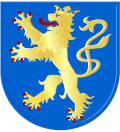 Coat of arms of the Duchy of Guelders.
 Coat of arms of the County of Cleves.


.jpg)
In 1096, Gerard IV, Lord of Wassenberg, ascended as Gerard I, Count of Guelders.[4] His successor, Gerard II, married Ermengarde, heiress of the Count of Zutphen. By that time, Guelders and Zutphen controlled two different parts of the region of Hamaland, which were joined through this marriage.
In the 12th and 13th centuries, Guelders quickly expanded downstream along the sides of the Meuse, Rhine, and IJssel rivers and even claimed the succession in the Duchy of Limburg, until it lost the 1288 Battle of Worringen against Berg and Brabant.
In 1129, the first settlement of the family at Wassenberg had been given, through marriage, to the Dukes of Limburg, which the Guelders family tried to recover through marriage with Ermengard, heiress of Limburg. However, following the War of the Limburg Succession, Limburg ended up annexed to the Duchy of Brabant. Cleves also participated in this conflict, and helped weaken the powerful Electorate of Cologne.
Relations between the two main branches continued, as in 1355 Guelders gave Zevenaar to the county of Cleves.
In 1339, Reginald II of Guelders was raised to ducal status. But the raise only meant more conflict: the sons of Reginald II confronted each other: the elder son Reginald was imprisoned by he younger one, Edward. As both died without male succession, in 1371 Edward's daughters warred each other for the possession of the duchy. The House of Jülich, through Maria of Guelders, eventually won the dispute.
Even the Cleves branch wasn't meant to last too much long. Upon the death of John of Cleves in 1368, the fief was inherited by his nephew Adolf III of the Marck. Cleves and the Marck were then ruled in personal union by the House of La Marck after Adolf's elder brother Engelbert had died without issue in 1391.
 Ruins of the Valkenburg Castle.

In 1082, Goswin, a brother of Gerard, first count of Guelders, was invested with the Lordship of Heinsberg. In 1168, in an inheritance division, emerged the Lordship of Falkenburg.[5] One of the most famous members of this branch is Beatrice of Falkenburg, married to the King of the Romans Richard of Cornwall.
At the end of the 12th century, the heiress of Heinsberg married her cousin from Cleves; this kept the lordship within the family, and prolonged it until 1217, when it was inherited by the House of Sponheim. The Falkenburg branch, in turn, went extinct in 1368; their land was inherited by the Van Schoonvorst family.
.jpg)

.jpg)


.jpg)


.jpg)
.jpg)
.jpg)


.jpg)


