Hurwitz problem
From Wikipedia, the free encyclopedia
In mathematics, the Hurwitz problem (named after Adolf Hurwitz) is the problem of finding multiplicative relations between quadratic forms which generalise those known to exist between sums of squares in certain numbers of variables.
There are well-known multiplicative relationships between sums of squares in two variables

(known as the Brahmagupta–Fibonacci identity), and also Euler's four-square identity and Degen's eight-square identity. These may be interpreted as multiplicativity for the norms on the complex numbers (), quaternions (), and octonions (), respectively.[1]: 1–3 [2]


The Hurwitz problem for the field K is to find general relations of the form

with the z being bilinear forms in the x and y: that is, each z is a K-linear combination of terms of the form xi yj.[3]: 127
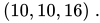
We call a triple admissible for K if such an identity exists.[1]: 125 Trivial cases of admissible triples include The problem is uninteresting for K of characteristic 2, since over such fields every sum of squares is a square, and we exclude this case. It is believed that otherwise admissibility is independent of the field of definition.[1]: 137