Huyghe Brewery
Belgian brewery
From Wikipedia, the free encyclopedia
Huyghe Brewery (Dutch: Brouwerij Huyghe) is a brewery founded in 1906 by Leon Huyghe in the city of Melle in East Flanders, Belgium. Its flagship beer is Delirium Tremens, a golden ale.

Brouwerij Huyghe in 2014 | |
Native name | Brouwerij Huyghe |
|---|---|
| Industry | Alcoholic beverage |
| Founded | 1906 |
| Founder | Leon Huyghe |
| Headquarters | , Belgium |
| Products | Beer |
| Owner | Alain Delaet |
Number of employees | 20 |
| Website | https://www.delirium.be/ |
History
In 1906, Leon Huyghe purchased an existing brewery in Melle[1] (at a site that had been in operation brewing beer since 1654). The brewery adopted the present name in 1938. While the company initially brewed a regular pilsner, it soon began brewing the kinds of beers now typically known as "Belgian".
Operations and products
The beers created at Huyghe include a series of beers under the "Delirium" tag that feature pink elephants on their labels.[2] The best known of these is Delirium Tremens, a blonde, Belgian ale.[3] Other beers brewed at Huyghe include a Christmas beer and a beer called "Deliria", selected to be brewed by the company from 65 entries made by women brewers.[3] In addition, the company makes a number of fruit beers with low ABV.[4]
Huyghe has acquired several smaller Belgian breweries, including Arteveld Grand Cru in 1987,[2] Brouwerij Biertoren in 1993, Brouwerij Dam in 1994, and Brouwerij Villers in 1999.[5]
Selected beers
- Delirium Nocturnum - Belgian brown ale, 8.5% alcohol[6][7]
- Delirium Noël - a winter seasonal offering, 10.0% ABV.
- Delirium Tremens - Belgian blond ale, 8.5% alcohol[8]
- Named as "Best Beer in the World" in 2008 at the World Beer Championships in Chicago, Illinois.[9][10] Stuart Kallen gives it the number one spot in his book, The 50 Greatest Beers in the World.[11]
Name controversy
The Delirium Tremens beer product was banned in the United States for a period of time when it was first exported there. The reason was that the authorities thought the imagery and name of the beer were "too provocative" and "encouraged excess drinking".[12][13]
Gallery
 St. Idesbald blond
 St. Idesbald dubbel
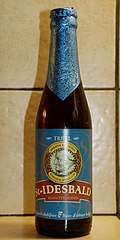 St. Idesbald tripel
 Viller's Brune
 La Guillotine Bier 3
 Delirium Tremens in Palm Springs
 Floris Passionfruit cider/beer, produced by the Huyghe Brewery


