Hygrocybe aurantipes
From Wikipedia, the free encyclopedia
| Hygrocybe aurantipes | |
|---|---|
 | |
 | |
| Ferndale Park, Sydney | |
Scientific classification  | |
| Domain: | Eukaryota |
| Kingdom: | Fungi |
| Division: | Basidiomycota |
| Class: | Agaricomycetes |
| Order: | Agaricales |
| Family: | Hygrophoraceae |
| Genus: | Hygrocybe |
| Species: | H. aurantipes |
| Binomial name | |
| Hygrocybe aurantipes | |
Hygrocybe aurantipes | |
|---|---|
 | Gills on hymenium |
 | Cap is conical |
 | Hymenium is adnate |
 | Stipe is bare |
 | Spore print is white |
 | Ecology is saprotrophic |
 | Edibility is unknown |
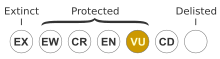
Hygrocybe aurantipes is a gilled fungus of the waxcap family found in a few scattered locations in wet forests in eastern Australia. It is a distinctive small mushroom with a 2–4 cm diameter olive-brown cap and golden-yellow stipe and gills, not easily confused with any other species. Known only from Lane Cove Bushland Park in Sydney's suburban Lower North Shore, Hazelbrook and Mount Wilson in the Blue Mountains, it has been designated as vulnerable as defined by the NSW Biodiversity Conservation Act 2016, by the New South Wales Government.
Hygrocybe aurantipes was originally collected by Ray and Elma Kearney in Lane Cove Bushland Park in Sydney's suburban Lower North Shore district on 17 June 1990, and officially described by Australian mycologist Tony Young in 1997.[1] Its specific epithet 'golden-footed' is derived from the Latin root aurant- 'gold' and pes 'foot'.[2]