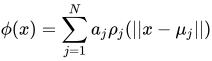
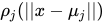
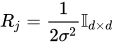
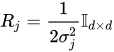
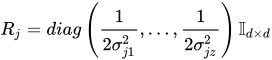
Training HyperBF networks involves estimation of weights  , shape and centers of neurons
  and
and  . Poggio and Girosi (1990) describe the training method with moving centers and adaptable neuron shapes. The outline of the method is provided below.
Consider the quadratic loss of the network ![{\displaystyle H[\phi ^{*}]=\sum _{i=1}^{N}(y_{i}-\phi ^{*}(x_{i}))^{2}}](https://wikimedia.org/api/rest_v1/media/math/render/svg/3bb8ce73fb7a2cf95034ba3f3b5a5bcd114e153f) . The following conditions must be satisfied at the optimum:
. The following conditions must be satisfied at the optimum:
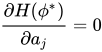
,
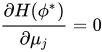
,
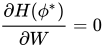
where  . Then in the gradient descent method the values of
  that minimize
 ![{\displaystyle H[\phi ^{*}]}](https://wikimedia.org/api/rest_v1/media/math/render/svg/3a42b9a80e03a9a9256c2335defe237fe682cc28) can be found as a stable fixed point of the following dynamic system:
can be found as a stable fixed point of the following dynamic system:
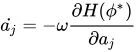
,
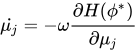
,
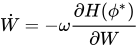
where  determines the rate of convergence.
Overall, training HyperBF networks can be computationally challenging. Moreover, the high degree of freedom of HyperBF leads to overfitting and poor generalization. However, HyperBF networks have an important advantage that a small number of neurons is enough for learning complex functions.[2]