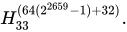
Hyperharmonic number
From Wikipedia, the free encyclopedia
In mathematics, the n-th hyperharmonic number of order r, denoted by , is recursively defined by the relations:


and
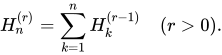
In particular, is the n-th harmonic number.

The hyperharmonic numbers were discussed by J. H. Conway and R. K. Guy in their 1995 book The Book of Numbers.[1]: 258
By definition, the hyperharmonic numbers satisfy the recurrence relation

In place of the recurrences, there is a more effective formula to calculate these numbers:

The hyperharmonic numbers have a strong relation to combinatorics of permutations. The generalization of the identity
![{\displaystyle H_{n}={\frac {1}{n!}}\left[{n+1 \atop 2}\right].}](https://wikimedia.org/api/rest_v1/media/math/render/svg/51ec1afb6b98d93994321cdc5740d3896519cb3c)
reads as
![{\displaystyle H_{n}^{(r)}={\frac {1}{n!}}\left[{n+r \atop r+1}\right]_{r},}](https://wikimedia.org/api/rest_v1/media/math/render/svg/610142bc3e6121792c3c94f1faffe8dc4148fb0d)
where is an r-Stirling number of the first kind.[2]
![{\displaystyle \left[{n \atop r}\right]_{r}}](https://wikimedia.org/api/rest_v1/media/math/render/svg/a5445c02c4cc23e08db9f8796f482e39235e83ab)
Asymptotics
The above expression with binomial coefficients easily gives that for all fixed order r>=2 we have.[3]
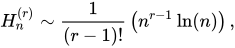
that is, the quotient of the left and right hand side tends to 1 as n tends to infinity.
An immediate consequence is that
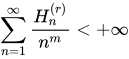
when m>r.
Generating function and infinite series
The generating function of the hyperharmonic numbers is
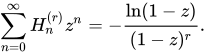
The exponential generating function is much more harder to deduce. One has that for all r=1,2,...

where 2F2 is a hypergeometric function. The r=1 case for the harmonic numbers is a classical result, the general one was proved in 2009 by I. Mező and A. Dil.[4]
The next relation connects the hyperharmonic numbers to the Hurwitz zeta function:[3]



![{\displaystyle (n,x)\in [0,x]\times [0,x]}](https://wikimedia.org/api/rest_v1/media/math/render/svg/6ab7410ab7bb6480b3886696a5d9170054e67998)

![{\displaystyle [0,x]\times [0,x]}](https://wikimedia.org/api/rest_v1/media/math/render/svg/b476181253571011a0cadb7903e20e738c4de28a)