IC 5063
From Wikipedia, the free encyclopedia
| IC 5063 | |
|---|---|
 IC 5063 with Hubble ACS and DESI legacy imaging surveys. The image shows the dust lanes and crepuscular rays. Image was created by Judy Schmidt. | |
| Observation data (J2000 epoch) | |
| Constellation | Indus |
| Right ascension | 20h 52m 02.15s |
| Declination | −57° 04′ 06.7″ |
| Redshift | 0.01126748±0.0005[1] |
| Heliocentric radial velocity | 3,402±6 km/s[2] |
| Galactocentric velocity | 3,342±6 km/s[2] |
| Distance | 160.8 ± 11.3 Mly (49.30 ± 3.45 Mpc)[2] |
| Apparent magnitude (V) | 13.60[3] |
| Apparent magnitude (B) | 12.92[4] |
| magnitude (J) | 9.705[5] |
| magnitude (H) | 9.024[5] |
| magnitude (K) | 8.750[5] |
| Characteristics | |
| Type | S0 or Sa[2] |
| Size | 46.24 kpc[2] |
| Other designations | |
| IC 5063, PGC 65600 | |
IC 5063 is a post-merger system[6] and is a Seyfert 2 galaxy.[7] This active galactic nucleus (AGN) produces on the one hand interactions with the interstellar medium (ISM) and large radio outflows. On the other hand, the accretion disk around the supermassive black hole, produces crepuscular rays.[8][9] It is the first discovered case of a black hole disk producing such rays,[9] but circumstellar disks around some young stars are already known to produce similar shadows.[10] The crepuscular rays were first noted in an image by Judy Schmidt, who posted her image of IC 5063 on the social media platform Twitter.[11]
A smaller galaxy, called IC 5064, is located to the south of IC 5063. These two galaxies have a similar redshift and form a pair of galaxies.[12]
IC 5063 was studied with ESO and CTIO instruments in 1991. This showed that the system is a post-merger system and has an extended-emission line region (EELR) in the galaxy nucleus. EELRs usually show strong emission due to doubly-ionized oxygen [O III]. In this work for the first time the X-shape of the emission was noted.[6] The first radio observation of the galaxy was published in 1998. This included radio continuum and H I region mapping with the Australia Telescope Compact Array. The radio emission is aligned with the emission by [O III].[7] The oxygen emission of [O III] was also imaged in higher resolution with Hubble WFPC2 and published in 2003.[13] In 2021 VLT/MUSE observations were published, including IC 5063. This showed that the [O III] extends up to around 10 kpc on each side.[14] Modelling has shown that the jet is expanding in a gaseous disk in the nucleus, destroying and displacing clouds in the central region.[15]
Various other molecular and atomic emission lines associated with the outflow were detected with various telescopes.[16][17][18][19][20][21] A molecular outflow was first detected in carbon monoxide (CO) in 2013 with the Atacama Pathfinder Experiment. The researchers suggested that the jet is accelerating molecules.[16] In 2014 this was confirmed, by showing that the jet is accelerating hydrogen gas molecules (H2) in a gaseous disk. This was based on spectroscopic observations with VLT/ISAAC. The researchers measured a speed of 600 km/s relative to the disk.[17] More detailed observations with ALMA showed a fast outflow of cold gas imaged in carbon monoxide (CO). The entire jet has a size of 1 kpc and CO showed a speed of 650 km/s at 0.5 kpc.[18] A later study, also using ALMA, found speeds of 800 km/s and a molecular outflow mass of more than 1.2 million M☉.[19] Near-infrared observations with VLT/SINFONI showed signatures of molecular and atomic gas that are distorted by the radio jet.[20] The galaxy was observed with JWST MIRI. This observation has shown that the gas sometimes exceeds the local escape velocity. Bow shocks in H2 show that the entire jet is more extended than seen in radio.[21] A giant loop of low ionized sulfur and nitrogen was observed perpendicular to the radio jet.[22]
The crepuscular rays, extending more than 11 kpc, were discovered in 2020 with Hubble observations. These are located perpendicular to the emission line region and the radio jets. Bright rays in the middle of the dark regions might indicate gaps in the obscuring material. From the shape of the dark rays it was estimated that the AGN torus has a wide opening angle of ≥137°.[9] The rays could also be explained by LINER-like outflows and bubbles that expand in a lateral direction, as is seen in one bubble in IC 5063.[22]
Gallery
 MUSE image of the X-shaped EELR and other emission features near the nucleus. Oxygen is blue, Hydrogen-alpha is orange, sulfur is green
 Hubble image of the EELR, with blue being H-alpha and nitrogen and green being sulfur. A faint giant loop is seen extending to the lower right, first discovered in 2021.[22]
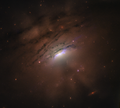 Hubble image showing both crepuscular rays and emission from the EELR in blue
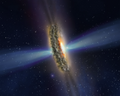 Artist's illustration depicting the explanation both the dark shadows and bright rays produced by a disk around the black hole


.png)
.png)
References
- ↑ Koss, Michael J.; Ricci, Claudio; Trakhtenbrot, Benny; Oh, Kyuseok; den Brok, Jakob S.; Mejía-Restrepo, Julian E.; Stern, Daniel; Privon, George C.; Treister, Ezequiel; Powell, Meredith C.; Mushotzky, Richard; Bauer, Franz E.; Ananna, Tonima T.; Baloković, Mislav; Bär, Rudolf E. (July 2022). "BASS. XXII. The BASS DR2 AGN Catalog and Data". The Astrophysical Journal Supplement Series. 261 (1): 2. arXiv:2207.12432. Bibcode:2022ApJS..261....2K. doi:10.3847/1538-4365/ac6c05. ISSN 0067-0049.
- 1 2 3 4 5 "IC 5063 | NASA/IPAC Extragalactic Database". ned.ipac.caltech.edu. Retrieved 2024-12-25.
- ↑ Véron-Cetty, M.-P.; Véron, P. (July 2010). "A catalogue of quasars and active nuclei: 13th edition". Astronomy and Astrophysics. 518: A10. Bibcode:2010A&A...518A..10V. doi:10.1051/0004-6361/201014188. ISSN 0004-6361.
- ↑ Lauberts, Andris; Valentijn, Edwin A. (1989). "The surface photometry catalogue of the ESO-Uppsala galaxies". Garching: European Southern Observatory. Bibcode:1989spce.book.....L.
- 1 2 3 Skrutskie, M. F.; Cutri, R. M.; Stiening, R.; Weinberg, M. D.; Schneider, S.; Carpenter, J. M.; Beichman, C.; Capps, R.; Chester, T.; Elias, J.; Huchra, J.; Liebert, J.; Lonsdale, C.; Monet, D. G.; Price, S. (February 2006). "The Two Micron All Sky Survey (2MASS)". The Astronomical Journal. 131 (2): 1163–1183. Bibcode:2006AJ....131.1163S. doi:10.1086/498708. ISSN 0004-6256.
- 1 2 Colina, L.; Sparks, W. B.; Macchetto, F. (March 1991). "IC 5063: A Merger Remnant with a Hidden Luminous Active Nucleus". The Astrophysical Journal. 370: 102. Bibcode:1991ApJ...370..102C. doi:10.1086/169795. ISSN 0004-637X.
- 1 2 Morganti, R.; Oosterloo, T.; Tsvetanov, Z. (March 1998). "A Radio Study of the Seyfert Galaxy IC 5063: Evidence for Fast Gas Outflow". The Astronomical Journal. 115 (3): 915–927. arXiv:astro-ph/9711285. Bibcode:1998AJ....115..915M. doi:10.1086/300236. ISSN 0004-6256.
- ↑ "Hubble Catches 'Shadow Play' of the Disk Around a Black Hole". HubbleSite. November 19, 2020. Retrieved 2024-12-25.
- 1 2 3 Maksym, W. Peter; Schmidt, Judy; Keel, William C.; Fabbiano, Giuseppina; Fischer, Travis C.; Bland-Hawthorn, Joss; Barth, Aaron J.; Elvis, Martin; Oosterloo, Tom; Ho, Luis C.; Kim, Minjin; Hwang, Hyunmo; Mayer, Evan (October 2020). "Crepuscular Rays from the Highly Inclined Active Galactic Nucleus in IC 5063". The Astrophysical Journal. 902 (1): L18. arXiv:2009.10153. Bibcode:2020ApJ...902L..18M. doi:10.3847/2041-8213/abb9b6. ISSN 0004-637X.
- ↑ Pontoppidan, K. M.; Dullemond, C. P. (May 2005). "Projection of circumstellar disks on their environments". Astronomy and Astrophysics. 435 (2): 595–610. arXiv:astro-ph/0502103. Bibcode:2005A&A...435..595P. doi:10.1051/0004-6361:20042059. ISSN 0004-6361.
- ↑ Plait, Phil (2020-11-22). "The tweet that led to a science paper about galactic crepuscular rays". SYFY Official Site. Retrieved 2024-12-25.
- ↑ Tully, R. Brent (May 2015). "Galaxy Groups: A 2MASS Catalog". The Astronomical Journal. 149 (5): 171. arXiv:1503.03134. Bibcode:2015AJ....149..171T. doi:10.1088/0004-6256/149/5/171. ISSN 0004-6256.
- ↑ Schmitt, H. R.; Donley, J. L.; Antonucci, R. R. J.; Hutchings, J. B.; Kinney, A. L. (October 2003). "A Hubble Space Telescope Survey of Extended [O III] λ5007 Emission in a Far-Infrared Selected Sample of Seyfert Galaxies: Observations". The Astrophysical Journal Supplement Series. 148 (2): 327–352. arXiv:astro-ph/0307254. Bibcode:2003ApJS..148..327S. doi:10.1086/377440. ISSN 0067-0049.
- ↑ Venturi, G.; Cresci, G.; Marconi, A.; Mingozzi, M.; Nardini, E.; Carniani, S.; Mannucci, F.; Marasco, A.; Maiolino, R.; Perna, M.; Treister, E.; Bland-Hawthorn, J.; Gallimore, J. (April 2021). "MAGNUM survey: Compact jets causing large turmoil in galaxies. Enhanced line widths perpendicular to radio jets as tracers of jet-ISM interaction". Astronomy and Astrophysics. 648: A17. arXiv:2011.04677. Bibcode:2021A&A...648A..17V. doi:10.1051/0004-6361/202039869. hdl:11384/139146. ISSN 0004-6361.
- ↑ Mukherjee, Dipanjan; Wagner, Alexander Y.; Bicknell, Geoffrey V.; Morganti, Raffaella; Oosterloo, Tom; Nesvadba, Nicole; Sutherland, Ralph S. (May 2018). "The jet-ISM interactions in IC 5063". Monthly Notices of the Royal Astronomical Society. 476 (1): 80–95. arXiv:1801.06875. Bibcode:2018MNRAS.476...80M. doi:10.1093/mnras/sty067. ISSN 0035-8711.
- 1 2 Morganti, R.; Frieswijk, W.; Oonk, R. J. B.; Oosterloo, T.; Tadhunter, C. (April 2013). "Tracing the extreme interplay between radio jets and the ISM in IC 5063". Astronomy and Astrophysics. 552: L4. arXiv:1302.2236. Bibcode:2013A&A...552L...4M. doi:10.1051/0004-6361/201220734. ISSN 0004-6361.
- 1 2 Tadhunter, C.; Morganti, R.; Rose, M.; Oonk, J. B. R.; Oosterloo, T. (July 2014). "Jet acceleration of the fast molecular outflows in the Seyfert galaxy IC 5063". Nature. 511 (7510): 440–443. arXiv:1407.1332. Bibcode:2014Natur.511..440T. doi:10.1038/nature13520. ISSN 0028-0836. PMID 25043049.
- 1 2 Morganti, Raffaella; Oosterloo, Tom; Oonk, J. B. Raymond; Frieswijk, Wilfred; Tadhunter, Clive (August 2015). "The fast molecular outflow in the Seyfert galaxy IC 5063 as seen by ALMA". Astronomy and Astrophysics. 580: A1. arXiv:1505.07190. Bibcode:2015A&A...580A...1M. doi:10.1051/0004-6361/201525860. ISSN 0004-6361.
- 1 2 Oosterloo, Tom; Raymond Oonk, J. B.; Morganti, Raffaella; Combes, Françoise; Dasyra, Kalliopi; Salomé, Philippe; Vlahakis, Nektarios; Tadhunter, Clive (December 2017). "Properties of the molecular gas in the fast outflow in the Seyfert galaxy IC 5063". Astronomy and Astrophysics. 608: A38. arXiv:1710.01570. Bibcode:2017A&A...608A..38O. doi:10.1051/0004-6361/201731781. ISSN 0004-6361.
- 1 2 Dasyra, K. M.; Bostrom, A. C.; Combes, F.; Vlahakis, N. (December 2015). "A Radio Jet Drives a Molecular and Atomic Gas Outflow in Multiple Regions within One Square Kiloparsec of the Nucleus of the nearby Galaxy IC5063". The Astrophysical Journal. 815 (1): 34. arXiv:1503.05484. Bibcode:2015ApJ...815...34D. doi:10.1088/0004-637X/815/1/34. ISSN 0004-637X.
- 1 2 Dasyra, Kalliopi M.; Paraschos, Georgios F.; Combes, Francoise; Patapis, Polychronis; Helou, George; Papachristou, Michalis; Fernandez-Ontiveros, Juan-Antonio; Bisbas, Thomas G.; Spinoglio, Luigi; Armus, Lee; Malkan, Matthew (December 2024). "A Case Study of Gas Impacted by Black-hole Jets with the JWST: Outflows, Bow Shocks, and High Excitation of the Gas in the Galaxy IC 5063". The Astrophysical Journal. 977 (2): 156. arXiv:2406.03218. Bibcode:2024ApJ...977..156D. doi:10.3847/1538-4357/ad89ba. ISSN 0004-637X.
- 1 2 3 Maksym, W. Peter; Fabbiano, Giuseppina; Elvis, Martin; Ho, Luis C.; Oosterloo, Tom; Ma, Jingzhe; Travascio, Andrea; Fischer, Travis C.; Keel, William C. (August 2021). "A Giant Loop of Ionized Gas Emerging from the Tumultuous Central Region of IC 5063". The Astrophysical Journal. 917 (2): 85. arXiv:2010.14542. Bibcode:2021ApJ...917...85M. doi:10.3847/1538-4357/ac0976. ISSN 0004-637X.