Ihara zeta function
From Wikipedia, the free encyclopedia
In mathematics, the Ihara zeta function is a zeta function associated with a finite graph. It closely resembles the Selberg zeta function, and is used to relate closed walks to the spectrum of the adjacency matrix. The Ihara zeta function was first defined by Yasutaka Ihara in the 1960s in the context of discrete subgroups of the two-by-two p-adic special linear group. Jean-Pierre Serre suggested in his book Trees that Ihara's original definition can be reinterpreted graph-theoretically. It was Toshikazu Sunada who put this suggestion into practice in 1985. As observed by Sunada, a regular graph is a Ramanujan graph if and only if its Ihara zeta function satisfies an analogue of the Riemann hypothesis.[1]
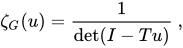
The Ihara zeta function is defined as the analytic continuation of the infinite product
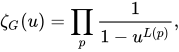
where L(p) is the length of . The product in the definition is taken over all prime closed geodesics of the graph , where geodesics which differ by a cyclic rotation are considered equal. A closed geodesic on (known in graph theory as a "reduced closed walk"; it is not a graph geodesic) is a finite sequence of vertices such that





The integer is the length . The closed geodesic is prime if it cannot be obtained by repeating a closed geodesic times, for an integer .


This graph-theoretic formulation is due to Sunada.