Independent dominating set
From Wikipedia, the free encyclopedia


In graph theory, an independent dominating set for a graph is a subset that is both a dominating set and an independent set; equivalently, it is a maximal independent set.[1]


The independent domination number of a graph is the size of the smallest independent dominating set (equivalently, the smallest maximal independent set).[1] The notation was introduced by Cockayne and Hedetniemi.[2][3]


The concept of an independent dominating set arose from chess problems. In 1862, de Jaenisch posed the problem of finding the minimum number of mutually non-attacking queens that can be placed on a chessboard so that every square is attacked by at least one queen.[4] Modelling the chessboard as a queen's graph , this minimum is the independent domination number . For the standard 8×8 queens graph, , , and .[1]


The theory of independent domination was formalized by Berge and Ore in 1962.[5][6] Berge observed that an independent set is maximal independent if and only if it is dominating, and that every maximal independent set is a minimal dominating set.[5]
Bounds
General bounds
Berge established basic bounds in terms of the order and maximum degree of a graph:[7]


For graphs without isolated vertices:[8]

and this bound is sharp. For a graph with minimum degree at least :[9]


confirming an earlier conjecture of Favaron.[8]
Graph families
For claw-free graphs:[10]

More generally, for -free (star-free) graphs where :[11]


For any bipartite graph without isolated vertices on vertices:[1]

For trees, if a tree has vertices and leaves:[12]


If is an -regular graph on vertices with no isolated vertex, then:[13]


For connected cubic graphs other than :[14]


It has been conjectured that the bound can be improved to for all connected cubic graphs of order more than 10.[1]

Regarding the ratio between domination and independent domination in connected cubic graphs other than :[15]

For any planar graph on vertices:[16]

For planar graphs of diameter 2, the bound can be improved:[16]

Relation to line graphs and edge domination
For any graph , its line graph is claw-free, and hence a minimum maximal independent set in is also a minimum dominating set in . An independent set in corresponds to a matching in , and a dominating set in corresponds to an edge dominating set in . Therefore a minimum maximal matching has the same size as a minimum edge dominating set.

Relation to other domination parameters
Because the minimum is taken over fewer sets (only the independent dominating sets are considered), for all graphs . Similarly, since every maximal independent set is an independent set, , where is the independence number. Furthermore, since every maximal independent set is a minimal dominating set, , where is the upper domination number (the maximum size of a minimal dominating set). This yields the domination chain:[17]


The inequality can be strict; there are graphs for which . For example, let be the double star graph consisting of vertices , where . The edges of are defined as follows: each is adjacent to , is adjacent to , and is adjacent to each . Then since is a smallest dominating set. If , then since is a smallest dominating set that is also independent (it is a smallest maximal independent set).




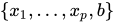
However, the bounds are simultaneously sharp for the corona of any graph , which satisfies .[1]


Cockayne and Mynhardt characterized which sequences of values are achievable:[18] A sequence of integers is realizable as for some graph if and only if , implies , and implies .


Computational complexity
Determining whether for a given graph and integer is NP-complete in general,[19] and remains NP-complete even when restricted to bipartite graphs, line graphs, circle graphs, unit disk graphs, or planar cubic graphs.[1] Furthermore, Irving showed that there is no polynomial-time algorithm to approximate the independent domination number within a constant factor unless P = NP.[20]


On the other hand, the independent domination number can be computed in linear time for trees[21] and in polynomial time for chordal graphs[22] and cocomparability graphs.[23]
Domination-perfect graphs
A graph is called a domination-perfect graph if in every induced subgraph of .[24] Since an induced subgraph of a claw-free graph is claw-free, it follows that every claw-free graph is also domination-perfect.[25]

By a result of Sumner and Moore, a graph is domination perfect if and only if for every induced subgraph with .[24] Zverovich and Zverovich gave a complete characterization: a graph is domination perfect if and only if it contains none of seventeen specific graphs as an induced subgraph.[26]


![{\displaystyle N[u]\cup N[v]}](https://wikimedia.org/api/rest_v1/media/math/render/svg/c74e907795696e83a4d62cfe2acc68d71b75c269)
