Inga sellowiana
From Wikipedia, the free encyclopedia
| Inga sellowiana | |
|---|---|
 | |
Scientific classification  | |
| Kingdom: | Plantae |
| Clade: | Tracheophytes |
| Clade: | Angiosperms |
| Clade: | Eudicots |
| Clade: | Rosids |
| Order: | Fabales |
| Family: | Fabaceae |
| Subfamily: | Caesalpinioideae |
| Clade: | Mimosoid clade |
| Genus: | Inga |
| Species: | I. sellowiana |
| Binomial name | |
| Inga sellowiana | |
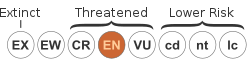
Inga sellowiana is an endangered species[1] of legume in the family Fabaceae, endemic to Brazil. It is an evergreen, perennial shrub or small tree, 1–8 metres (3.3–26.2 ft) in height.[2] Common names include ingá mirim, ingá ferro, ingá xixica and ingá xixi.[2]
It is found only in Brazil, specifically in the Southeast (São Paulo, Rio de Janeiro) and South (Paraná, Santa Catarina) Regions.[3][4] It has pentamerous white flowers which bloom from November through March, and from May through June.[2]
