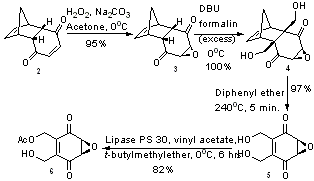
The total laboratory synthesis of integrasone has been worked out, starting with a commonly available Diels-Alder adduct of p-benzoquinone and cyclopentadiene. Using a base mediated epoxidation reaction, structure 3 was achieved, which led to structure 4 after exhaustive hydroxymethylation in the presence of DBU. The formation of structure 4 is particularly impressive – it not only forms two important C-C bonds in one step, but also occurs in quantitative yield. Using a retro Diels-Alder reaction, structure 5 was formed in near quantitative yield.[5] Structure 5 was desymmetrized through an enzymatic transesterification process, using an immobilized lipase PS 30 enzyme to give structure 6, which was formed with a 99% enantiomeric excess.[6]
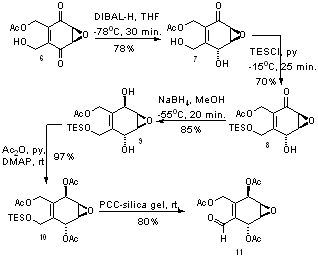
The stereochemistry of the hydroxyl group at carbon 6 in the final integrasone molecule (3) was determined by reduction, which was both regio and stereo selective due to the directing effects of the primary hydroxyl group (carbon 8) and the epoxide ring (carbons 4 and 5). The hydroxy group on carbon 8 is then selectively protected with as the triethylsilyl (TES) ether to give structure 8. With the hydroxyl groups on both carbons 1 and 8 protected, it is then relatively straightforward to stereoselectively reduce the carbonyl group on carbon 3 with sodium borohydride to give the diol depicted in structure 9. Before any oxidation reactions could be used, the two newly formed hydroxyl groups were protected with as acetate esters, forming structure 10. The TES protecting group on the carbon 8 hydroxyl was removed without deprotecting any of the other groups, and then the carbon 8 hydroxyl was oxidized with PCC[7] to give the aldehyde shown in structure 11.
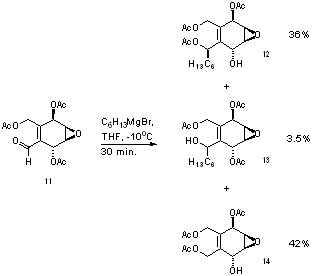
The next step involved the installation of a hexyl chain at the aldehyde carbon (carbon 8). This was accomplished using the Grignard reagent hexylmagnesium bromide, and was highly stereoselective – so much so that the chemists reporting this reaction express their “delight”.[8] It is speculated that this stereoselectivity for product 12 is due to the directing influence of the acetate group attached to carbon 6, which migrates during the reaction to carbon 8. Unfortunately, in 42% of the product, the alkyl chain was not installed, and instead the aldehyde was reduced with an accompanying acetate migration to form a triacetate (structure 14). Efforts to improve this step of the synthesis were made by attempting to vary the temperature and solvent. At high temperatures, more of the triacetate 14 was formed, while at low temperatures, the reaction was sluggish.[8]
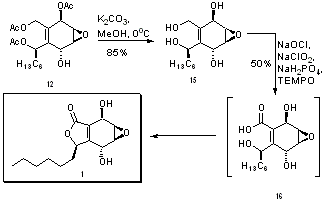
Structure 12 is very close to the target molecule, 1 – all that remains is to close the 5-membered ring and form a carbonyl. Base hydrolysis was used to remove the remaining acetate protecting groups, resulting in the tetrol depicted in structure 15. Integrasone (1) is then formed in a single step by oxidation of the primary hydroxyl groups and concerted electron cyclization to form the ring, using sodium chlorite catalyzed by TEMPO and bleach.[9] Structure 16 is a transition state proposed to explain the concerted electrocyclic reaction and the carbonyl formation.[10]