Interval propagation
From Wikipedia, the free encyclopedia
In numerical mathematics, interval propagation or interval constraint propagation is the problem of contracting interval domains associated to variables of R without removing any value that is consistent with a set of constraints (i.e., equations or inequalities). It can be used to propagate uncertainties in the situation where errors are represented by intervals.[1] Interval propagation considers an estimation problem as a constraint satisfaction problem.
Atomic contractors
A contractor associated to an equation involving the variables x1,...,xn is an operator which contracts the intervals [x1],..., [xn] (that are supposed to enclose the xi's) without removing any value for the variables that is consistent with the equation.
A contractor is said to be atomic if it is not built as a composition of other contractors. The main theory that is used to build atomic contractors are based on interval analysis.
Example. Consider for instance the equation

which involves the three variables x1,x2 and x3.
The associated contractor is given by the following statements
![{\displaystyle [x_{3}]:=[x_{3}]\cap ([x_{1}]+[x_{2}])}](http://wikimedia.org/api/rest_v1/media/math/render/svg/732528ad8bf9b28b0851b638dbf10a59704283c7)
![{\displaystyle [x_{1}]:=[x_{1}]\cap ([x_{3}]-[x_{2}])}](http://wikimedia.org/api/rest_v1/media/math/render/svg/90c40d48a96a2a1d34be728721c0fc05e489cc11)
![{\displaystyle [x_{2}]:=[x_{2}]\cap ([x_{3}]-[x_{1}])}](http://wikimedia.org/api/rest_v1/media/math/render/svg/da4cbddbe15d801c3de706a117942a6b45c30a00)
For instance, if
![{\displaystyle x_{1}\in [-\infty ,5],}](http://wikimedia.org/api/rest_v1/media/math/render/svg/b2b6c7d96609b720e0839ff5bf0ead4beb92052c)
![{\displaystyle x_{2}\in [-\infty ,4],}](http://wikimedia.org/api/rest_v1/media/math/render/svg/9db43b4901aa98257c1aeb8e476a9c28624a28e0)
![{\displaystyle x_{3}\in [6,\infty ]}](http://wikimedia.org/api/rest_v1/media/math/render/svg/0cce7f1c0b9268d4593fc1d12e2decc7590583b0)
the contractor performs the following calculus
![{\displaystyle x_{3}=x_{1}+x_{2}\Rightarrow x_{3}\in [6,\infty ]\cap ([-\infty ,5]+[-\infty ,4])=[6,\infty ]\cap [-\infty ,9]=[6,9].}](http://wikimedia.org/api/rest_v1/media/math/render/svg/4f6f64a60a4628434b81fd529da46b17aceed9b1)
![{\displaystyle x_{1}=x_{3}-x_{2}\Rightarrow x_{1}\in [-\infty ,5]\cap ([6,\infty ]-[-\infty ,4])=[-\infty ,5]\cap [2,\infty ]=[2,5].}](http://wikimedia.org/api/rest_v1/media/math/render/svg/c8c564fe464fe6118e57fb401dab9eed8ea108b5)
![{\displaystyle x_{2}=x_{3}-x_{1}\Rightarrow x_{2}\in [-\infty ,4]\cap ([6,\infty ]-[-\infty ,5])=[-\infty ,4]\cap [1,\infty ]=[1,4].}](http://wikimedia.org/api/rest_v1/media/math/render/svg/7974daac866a947d873a3bc8b5f75de76cf512e6)


For other constraints, a specific algorithm for implementing the atomic contractor should be written. An illustration is the atomic contractor associated to the equation
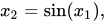
is provided by Figures 1 and 2.
Decomposition
For more complex constraints, a decomposition into atomic constraints (i.e., constraints for which an atomic contractor exists) should be performed. Consider for instance the constraint

could be decomposed into


The interval domains that should be associated to the new intermediate variables are
![{\displaystyle a\in [-\infty ,\infty ],}](http://wikimedia.org/api/rest_v1/media/math/render/svg/a8578c13eeee2dabddbbe333f85eadb6df4a92bc)
![{\displaystyle b\in [-1,1],}](http://wikimedia.org/api/rest_v1/media/math/render/svg/d106e33944553d0c7a17e223ed20134e366cc985)
![{\displaystyle c\in [-\infty ,0].}](http://wikimedia.org/api/rest_v1/media/math/render/svg/8d50fb2d2dc32061898dab423a36c5825de4e241)
Propagation
The principle of the interval propagation is to call all available atomic contractors until no more contraction could be observed. [2] As a result of the Knaster-Tarski theorem, the procedure always converges to intervals which enclose all feasible values for the variables. A formalization of the interval propagation can be made thanks to the contractor algebra. Interval propagation converges quickly to the result and can deal with problems involving several hundred of variables. [3]
Example
Consider the electronic circuit of Figure 3.

Assume that from different measurements, we know that
![{\displaystyle E\in [23V,26V]}](http://wikimedia.org/api/rest_v1/media/math/render/svg/185b34b34288964ae81dda50bf6ab7c3ee78c353)
![{\displaystyle I\in [4A,8A]}](http://wikimedia.org/api/rest_v1/media/math/render/svg/e5d1f323240d3a82e83cd95e8f22eaeb53cdb85d)
![{\displaystyle U_{1}\in [10V,11V]}](http://wikimedia.org/api/rest_v1/media/math/render/svg/ab05c079717be65686ba5eab9377f233a24473b7)
![{\displaystyle U_{2}\in [14V,17V]}](http://wikimedia.org/api/rest_v1/media/math/render/svg/410fd82a58749506ba8bcff3ba66ae1cd47bc4ed)
![{\displaystyle P\in [124W,130W]}](http://wikimedia.org/api/rest_v1/media/math/render/svg/220fd970a4c0d720b155e032933d8a1d3fce49a1)
![{\displaystyle R_{1}\in [0\Omega ,\infty ]}](http://wikimedia.org/api/rest_v1/media/math/render/svg/f7642fd80ec697592a4dfe9265c94ac4db791c82)
![{\displaystyle R_{2}\in [0\Omega ,\infty ].}](http://wikimedia.org/api/rest_v1/media/math/render/svg/bd022b00e1abe16dc879ff97b5bd3cbaacb4092a)
From the circuit, we have the following equations



After performing the interval propagation, we get
![{\displaystyle E\in [24V,26V]}](http://wikimedia.org/api/rest_v1/media/math/render/svg/43b5243705cb4b19efc88d7ca30f5e1235595127)
![{\displaystyle I\in [4.769A,5.417A]}](http://wikimedia.org/api/rest_v1/media/math/render/svg/c53048434ae992e64734b24fcb414b43dcca599d)
![{\displaystyle U_{2}\in [14V,16V]}](http://wikimedia.org/api/rest_v1/media/math/render/svg/edea49c3f113c9d892db0b508d29f3bb4c847acf)
![{\displaystyle R_{1}\in [1.846\Omega ,2.307\Omega ]}](http://wikimedia.org/api/rest_v1/media/math/render/svg/99d6b870dd044ad6d088e56b3619679522144583)
![{\displaystyle R_{2}\in [2.584\Omega ,3.355\Omega ].}](http://wikimedia.org/api/rest_v1/media/math/render/svg/b35f1f8750041d48e87e90456a7ec79fa49745f7)