Inverse Pythagorean theorem
From Wikipedia, the free encyclopedia

| Base triple | AC | BC | CD | AB | |
|---|---|---|---|---|---|
| (3, 4, 5) | 20 = 4× 5 | 15 = 3× 5 | 12 = 3× 4 | 25 = 52 | |
| (5, 12, 13) | 156 = 12×13 | 65 = 5×13 | 60 = 5×12 | 169 = 132 | |
| (8, 15, 17) | 255 = 15×17 | 136 = 8×17 | 120 = 8×15 | 289 = 172 | |
| (7, 24, 25) | 600 = 24×25 | 175 = 7×25 | 168 = 7×24 | 625 = 252 | |
| (20, 21, 29) | 609 = 21×29 | 580 = 20×29 | 420 = 20×21 | 841 = 292 | |
| All positive integer primitive inverse-Pythagorean triples having up to three digits, with the hypotenuse for comparison | |||||
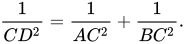
In geometry, the inverse Pythagorean theorem (also known as the reciprocal Pythagorean theorem[1] or the upside down Pythagorean theorem[2]) is as follows:[3]
- Let A, B be the endpoints of the hypotenuse of a right triangle △ABC. Let D be the foot of a perpendicular dropped from C, the vertex of the right angle, to the hypotenuse. Then
This theorem should not be confused with proposition 48 in book 1 of Euclid's Elements, the converse of the Pythagorean theorem, which states that if the square on one side of a triangle is equal to the sum of the squares on the other two sides then the other two sides contain a right angle.
The area of triangle △ABC can be expressed in terms of either AC and BC, or AB and CD:
^{2}&=(AB\cdot CD)^{2}\\[4pt]{\frac {1}{CD^{2}}}&={\frac {AB^{2}}{AC^{2}\cdot BC^{2}}}\end{aligned}}}](https://wikimedia.org/api/rest_v1/media/math/render/svg/f13fb9108ba6c96078ad0f949cb45ae66691e323)
given CD > 0, AC > 0 and BC > 0.
Using the Pythagorean theorem,
![{\displaystyle {\begin{aligned}{\frac {1}{CD^{2}}}&={\frac {BC^{2}+AC^{2}}{AC^{2}\cdot BC^{2}}}\\[4pt]&={\frac {BC^{2}}{AC^{2}\cdot BC^{2}}}+{\frac {AC^{2}}{AC^{2}\cdot BC^{2}}}\\[4pt]\quad \therefore \;\;{\frac {1}{CD^{2}}}&={\frac {1}{AC^{2}}}+{\frac {1}{BC^{2}}}\end{aligned}}}](https://wikimedia.org/api/rest_v1/media/math/render/svg/117cc5f43ba8ba617a278ad337b2a9ad5ec18027)
as above.
Note in particular:
![{\displaystyle {\begin{aligned}{\tfrac {1}{2}}AC\cdot BC&={\tfrac {1}{2}}AB\cdot CD\\[4pt]CD&={\tfrac {AC\cdot BC}{AB}}\\[4pt]\end{aligned}}}](https://wikimedia.org/api/rest_v1/media/math/render/svg/3568e8b4c2f2792d3e08b8f06654c6530eab06cb)
Special case of the cruciform curve
The cruciform curve or cross curve is a quartic plane curve given by the equation

where the two parameters determining the shape of the curve, a and b are each CD.
Substituting x with AC and y with BC gives
![{\displaystyle {\begin{aligned}AC^{2}BC^{2}-CD^{2}AC^{2}-CD^{2}BC^{2}&=0\\[4pt]AC^{2}BC^{2}&=CD^{2}BC^{2}+CD^{2}AC^{2}\\[4pt]{\frac {1}{CD^{2}}}&={\frac {BC^{2}}{AC^{2}\cdot BC^{2}}}+{\frac {AC^{2}}{AC^{2}\cdot BC^{2}}}\\[4pt]\therefore \;\;{\frac {1}{CD^{2}}}&={\frac {1}{AC^{2}}}+{\frac {1}{BC^{2}}}\end{aligned}}}](https://wikimedia.org/api/rest_v1/media/math/render/svg/dc62e1039c045c50b1d8bd1fa494a98f8f22c9d6)
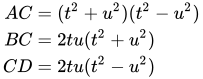
Inverse-Pythagorean triples can be generated using integer parameters t and u as follows.[4]