Inverse square potential
From Wikipedia, the free encyclopedia
In quantum mechanics, the inverse square potential is a form of a central force potential which has the unusual property of the eigenstates of the corresponding Hamiltonian operator remaining eigenstates in a scaling of all cartesian coordinates by the same constant.[1] Apart from this curious feature, it's by far less important central force problem than that of the Keplerian inverse square force system.
The potential energy function of an inverse square potential is
,
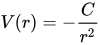
where is some constant and is the Euclidean distance from some central point. If is positive, the potential is attractive and if is negative, the potential is repulsive. The corresponding Hamiltonian operator is


,
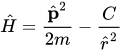
where is the mass of the particle moving in the potential.

![{\displaystyle [{\hat {x}}_{i},{\hat {p}}_{i}]=i\hbar }](https://wikimedia.org/api/rest_v1/media/math/render/svg/29332d10932741647cfa29dc4a06bd5594f2a0f8)


