Inverse tangent integral
From Wikipedia, the free encyclopedia
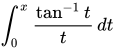
The inverse tangent integral is a special function, defined by:
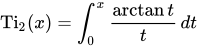
Equivalently, it can be defined by a power series, or in terms of the dilogarithm, a closely related special function.
The inverse tangent integral is defined by:
The arctangent is taken to be the principal branch; that is, −π/2 < arctan(t) < π/2 for all real t.[1]
Its power series representation is

which is absolutely convergent for [1]

The inverse tangent integral is closely related to the dilogarithm and can be expressed simply in terms of it:
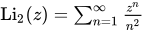

That is,

for all real x.[1]
Properties
The inverse tangent integral is an odd function:[1]

The values of Ti2(x) and Ti2(1/x) are related by the identity
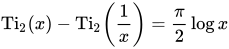
valid for all x > 0 (or, more generally, for Re(x) > 0). This can be proven by differentiating and using the identity .[2][3]

The special value Ti2(1) is Catalan's constant .[3]

Generalizations
Similar to the polylogarithm , the function
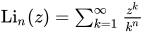

is defined analogously. This satisfies the recurrence relation:[4]
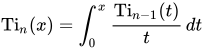
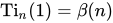
By this series representation it can be seen that the special values , where represents the Dirichlet beta function.