Inversive distance
From Wikipedia, the free encyclopedia
In inversive geometry, the inversive distance is a way of measuring the "distance" between two circles, regardless of whether the circles cross each other, are tangent to each other, or are disjoint from each other.[1]
The inversive distance remains unchanged if the circles are inverted, or transformed by a Möbius transformation.[1][2][3] One pair of circles can be transformed to another pair by a Möbius transformation if and only if both pairs have the same inversive distance.[1]
An analogue of the Beckman–Quarles theorem holds true for the inversive distance: if a bijection of the set of circles in the inversive plane preserves the inversive distance between pairs of circles at some chosen fixed distance , then it must be a Möbius transformation that preserves all inversive distances.[3]

Distance formula
For two circles in the Euclidean plane with radii and , and distance between their centers, the inversive distance can be defined by the formula[1]


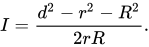
This formula gives:
- a value greater than 1 for two disjoint circles,
- a value of 1 for two circles that are tangent to each other and both outside each other,
- a value between −1 and 1 for two circles that intersect,
- a value of 0 for two circles that intersect each other at right angles,
- a value of −1 for two circles that are tangent to each other, one inside of the other,
- and a value less than −1 when one circle contains the other.
(Some authors define the absolute inversive distance as the absolute value of the inversive distance.)
Some authors modify this formula by taking the inverse hyperbolic cosine of the value given above, rather than the value itself.[2][4][5] That is, rather than using the number as the inversive distance, the distance is instead defined as the number obeying the equation

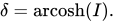
Although transforming the inversive distance in this way makes the distance formula more complicated, and prevents its application to crossing pairs of circles, it has the advantage that (like the usual distance for points on a line) the distance becomes additive for circles in a pencil of circles. That is, if three circles belong to a common pencil, then (using in place of as the inversive distance) one of their three pairwise distances will be the sum of the other two.[2]
In other geometries
It is also possible to define the inversive distance for circles on a sphere, or for circles in the hyperbolic plane.[1]

