Irrationality sequence
From Wikipedia, the free encyclopedia
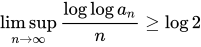
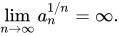
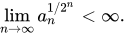
In mathematics, a sequence of positive integers an is called an irrationality sequence if it has the property that for every sequence xn of positive integers, the sum of the series

exists (that is, it converges) and is an irrational number.[1][2] The problem of characterizing irrationality sequences was posed by Paul Erdős and Ernst G. Straus, who originally called the property of being an irrationality sequence "Property P".[3]
The powers of two whose exponents are powers of two, , form an irrationality sequence. However, although Sylvester's sequence

- 2, 3, 7, 43, 1807, 3263443, ...
(in which each term is one more than the product of all previous terms) also grows doubly exponentially, it does not form an irrationality sequence. For, letting for all gives



a series converging to a rational number. Likewise, the factorials, , do not form an irrationality sequence because the sequence given by for all leads to a series with a rational sum,