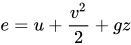
We skip the analysis of the x-component of the momentum and move on to the first law of thermodynamics, which is

First term of L.H.S, next three terms of L.H.S and first term of R.H.S are zero due to assumption (3), (4) and (1) respectively.
where,
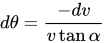
For our control volume we obtain
![{\displaystyle 0=\left(h+{\frac {v^{2}}{2}}\right)(-\rho v\sin \alpha A)+\left[(h+dh)+{\frac {(v+dv)^{2}}{2}}\right]{\bigl (}(\rho +d\rho )(v+dv)\sin(\alpha -d\theta )A{\bigr )}}](https://wikimedia.org/api/rest_v1/media/math/render/svg/f7c29e4fd02a444e4aba509f82dbdcd9221016c5)
This may be simplified as

Expanding and simplifying in the limit to first order, we get

If we confine to ideal gases,  , so
, so

Above equation relates the differential changes in velocity and temperature. We can derive a relation between  and
and  using
using  . Differentiating (and dividing the left hand side by and the right by
  ),
),
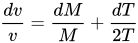
Using equation (1.6)
![{\displaystyle {\begin{aligned}{\frac {dv}{v}}&={\frac {dM}{M}}-{\frac {vdv}{2c_{p}T}}\\[2pt]&={\frac {dM}{M}}-{\frac {dv{\frac {v^{2}}{c_{p}T}}}{2v}}\\[2pt]&={\frac {dM}{M}}-{\frac {dv{\frac {M^{2}c^{2}}{c_{p}T}}}{2v}}\\[2pt]&={\frac {dM}{M}}-{\frac {dv{\frac {M^{2}kRT}{c_{p}T}}}{2v}}\\[2pt]&={\frac {dM}{M}}-{\frac {dv[M^{2}(k-1)]}{2v}}\end{aligned}}}](https://wikimedia.org/api/rest_v1/media/math/render/svg/3839923615443144e10ceae5d5fe003dba664847)
Hence,

Combining (1.4) and (1.7)

We generally apply the above equation to negative  , let
, let  . We can integrate this between the initial and final Mach numbers of given flow, but it will be more convenient to integrate from a reference state, the critical speed (
 ) to Mach number , with
  arbitrarily set to zero at ,

Leading to Prandtl-Meyer supersonic expansion function,
![{\displaystyle \omega ={\sqrt {\frac {k+1}{k-1}}}\tan ^{-1}\left[{\frac {\sqrt {k-1}}{\sqrt {k+1}}}(M^{2}-1)\right]-\tan ^{-1}(M^{2}-1)}](https://wikimedia.org/api/rest_v1/media/math/render/svg/d6e675a5e7e11c4efdb9a6f74828dcd5618d6891)