Ivry-sur-Seine
Commune in Île-de-France, France
From Wikipedia, the free encyclopedia
Ivry-sur-Seine (French pronunciation: [ivʁi syʁ sɛn]; lit. 'Ivry-on-Seine') or simply Ivry is a commune in the Val-de-Marne department in the southeastern suburbs of Paris, France. It is located 5.3 km (3+1⁄4 mi) from the centre of Paris.

Ivry-sur-Seine | |
|---|---|
_-_2021-03-23_-_1.jpg) The Hôtel de Ville | |
 Coat of arms | |
 Location (in red) within Paris inner suburbs | |
 Location of Ivry-sur-Seine | |
  Ivry-sur-Seine  Ivry-sur-Seine | |
| Coordinates: 48°48′28″N 2°22′29″E | |
| Country | France |
| Region | Île-de-France |
| Department | Val-de-Marne |
| Arrondissement | L'Haÿ-les-Roses |
| Canton | Ivry-sur-Seine |
| Intercommunality | Grand Paris |
| Government | |
| • Mayor (2020–2026) | Philippe Bouyssou (PCF)[1] |
Area 1 | 6.10 km2 (2.36 sq mi) |
| Population (2023)[2] | 65,064 |
| • Density | 10,700/km2 (27,600/sq mi) |
| Demonym | Ivryens |
| Time zone | UTC+01:00 (CET) |
| • Summer (DST) | UTC+02:00 (CEST) |
| INSEE/Postal code | 94041 /94200 |
| Elevation | 28–68 m (92–223 ft) |
| Website | www |
| 1 French Land Register data, which excludes lakes, ponds, glaciers > 1 km2 (0.386 sq mi or 247 acres) and river estuaries. | |
Paris's main Asian district, the Quartier Asiatique in the 13th arrondissement, borders the commune and now extends into the northern parts of Ivry. Asian commercial activity, especially Chinese and Vietnamese, has greatly increased in Ivry-sur-Seine during the past two decades. The commune contains one of the highest concentrations of Vietnamese in France, who began settling in the city in the late 1970s after the Vietnam War.[3]
Politically, Ivry-sur-Seine has historically demonstrated strong electoral support for the French Communist Party (PCF). Between 1925 and today (except for the period of German occupation in World War II), the office of mayor was held by just four individuals: Georges Marrane, Jacques Laloë, Pierre Gosnat and Philippe Bouyssou, all members of the Communist Party.
Ivry-sur-Seine is twinned with Bishop Auckland in County Durham, England.
Name
Originally, Ivry-sur-Seine was called simply Ivry. The name Ivry comes from Medieval Latin Ivriacum or Ibriacum, perhaps meaning "estate of Eburius (the Latinized form of the Gallic patronym Eburos)", a Gallo-Roman landowner.
In 1897, the name of the commune officially became Ivry-sur-Seine (meaning "Ivry upon Seine"), in order to distinguish it from other communes of France also called Ivry.
History
On 1 January 1860, the city of Paris was enlarged by annexing neighbouring communes. On that occasion, about a third of the commune of Ivry-sur-Seine was annexed to Paris, and now forms the Chinatown area of the 13th arrondissement of Paris. The Hôtel de Ville was completed in 1896.[4]
Ivry-sur-Seine is perhaps most famous as the place of execution of Jean Bastien-Thiry in March 1963. Richard Ellman also notes that James Joyce's daughter, Lucia, received psychiatric treatment in the commune's hospital in 1936 and was visited by both Joyce and Samuel Beckett.[5]
Economy
Transport
Ivry-sur-Seine is served by two stations on the Paris Métro Line 7: Pierre et Marie Curie and Mairie d'Ivry.
The east of the commune is served by Ivry-sur-Seine station on Paris RER line C with stops at the Bibliothèque Nationale de France and the city centre.
Orly Airport is located to the south of Ivry-sur-Seine.
Education
Senior high schools:
- Collège et lycée Romain Rolland
- Lycée technique Fernand Léger
Colleges and universities:
Images from Ivry
 Ivry RER Railway Station
 Old Windmill (Moulin de la Tour) near the 13th Arrondissement
 October Sky
Ivry sur Seine Church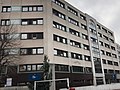 Main Building IPSA Paris
![Les Étoiles d'Ivry [fr]](//upload.wikimedia.org/wikipedia/en/thumb/d/d6/Etoiles_d%27Ivry_%40_Brutalist_housing_project_%40_Jean_Renaudie_%40_Place_Voltaire_%40_Ivry-sur-Seine_%2830035600293%29.jpg/120px-Etoiles_d%27Ivry_%40_Brutalist_housing_project_%40_Jean_Renaudie_%40_Place_Voltaire_%40_Ivry-sur-Seine_%2830035600293%29.jpg) Les Étoiles d'Ivry
Les Étoiles d'Ivry


![Les Étoiles d'Ivry [fr]](#/media/File:Etoiles_d'Ivry_@_Brutalist_housing_project_@_Jean_Renaudie_@_Place_Voltaire_@_Ivry-sur-Seine_(30035600293).jpg)
Demographics
Historical population | ||||||||||||||||||||||||||||||||||||||||||||||||||||||||||||||||||||||||||||||||||||||||||||||||||||||||||||||||||||||
|
| |||||||||||||||||||||||||||||||||||||||||||||||||||||||||||||||||||||||||||||||||||||||||||||||||||||||||||||||||||||
 | ||||||||||||||||||||||||||||||||||||||||||||||||||||||||||||||||||||||||||||||||||||||||||||||||||||||||||||||||||||||
| Source: EHESS[9] and INSEE (1968-2023)[10] | ||||||||||||||||||||||||||||||||||||||||||||||||||||||||||||||||||||||||||||||||||||||||||||||||||||||||||||||||||||||
Immigration
| Born in metropolitan France | Born outside metropolitan France | |||
|---|---|---|---|---|
| 73.5% | 26.5% | |||
| Born in overseas France |
Born in foreign countries with French citizenship at birth1 | EU-15 immigrants2 | Non-EU-15 immigrants | |
| 2.2% | 2.7% | 4.7% | 16.9% | |
| 1 This group is made up largely of former French settlers, such as pieds-noirs in Northwest Africa, followed by former colonial citizens who had French citizenship at birth (such as was often the case for the native elite in French colonies), as well as to a lesser extent foreign-born children of French expatriates. A foreign country is understood as a country not part of France in 1999, so a person born for example in 1950 in Algeria, when Algeria was an integral part of France, is nonetheless listed as a person born in a foreign country in French statistics. 2 An immigrant is a person born in a foreign country not having French citizenship at birth. An immigrant may have acquired French citizenship since moving to France, but is still considered an immigrant in French statistics. On the other hand, persons born in France with foreign citizenship (the children of immigrants) are not listed as immigrants. | ||||
As of circa 1998 Ivry and Vitry-sur-Seine had a combined Asian population of 3,600. That year about 250 Asians from those communes worked in the 13th arrondissement of Paris, and the overall demographics of Ivry and Vitry Asians were similar to those in the 13th arrondissement.[11]
Notable people
- Hannibal Mejbri, football player
- Luc Abalo, handball player
- Nicolas Appert (1749–1841), inventor, spent a number of years in Ivry-sur-Seine
- Antonin Artaud, writer, died in Ivry-sur-Seine on 4 March 1948.
- Yohann Auvitu, ice hockey player
- Souleymane Bamba, footballer
- Paul Boccara, economist and historian.
- Pierre-Claude-Victor Boiste (1765–1824), lexicographer
- Yannick Bonheur, figure skater
- Pierre Contant d'Ivry (1698–1777), architect born in Ivry-sur-Seine.
- Raymond Daudel (1920–2006), chemist, died in Ivry-sur-Seine
- Mana Dembele, footballer
- Kadidiatou Diani, footballer
- Jean Ferrat, singer, spent a number of years in Ivry-sur-Seine before settling in Ardèche.
- Catherine Ferry, singer
- Renée Gailhoustet
- Alla Ilchun, fashion model, a muse for Christian Dior
- Reda Kateb, actor
- Tripy Makonda, footballer
- Dany N'Guessan, footballer
- Doriane Pin, racing driver
- Jean Renaudie, architect and founder of the Atelier de Montrouge who was responsible for the complete renovation of Ivry town centre.
- Henri Rol-Tanguy, member of the French Resistance, died in Ivry-sur-Seine on September 8, 2002
- Bakary Sako, footballer
- Antoine Spire, sociologist and writer.
- Maurice Thorez, former leader of the French Communist Party, elected deputy for d'Ivry-sur-Seine in 1932 until his death in 1964.
- Mickael Toti, basketball player
- Makan Traore, footballer
- Bano Traore, athlete

