Izbash formula
From Wikipedia, the free encyclopedia
The Izbash formula is a mathematical expression used to calculate the stability of armourstone in flowing water environments.
For the assessment of granular material stability in a current, the Shields formula and the Izbash formula are commonly employed. The former is more appropriate for fine-grained materials like sand and gravel, whereas the Izbash formula is tailored for larger stone sizes. The Izbash formula was devised by Sergei Vladimirovich Izbash. Its general expression is as follows:[1]
- or alternatively
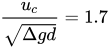
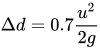
Here, the variables represent:
- uc = flow velocity in proximity to the stone
- Δ = relative density of the stone, calculated as (ρs - ρw)/ρw where ρs denotes the stone's density and ρw is the water's density
- g = gravitational acceleration
- d = diameter of the stone
The coefficient 1.7 is an experimental constant determined by Izbash, encapsulating effects such as friction, inertia, and the turbulence of the current. Hence, the application of this coefficient is limited to conditions where turbulence is predominantly induced by the roughness of the construction materials in water. Adjustments are necessary when these conditions do not apply.

The derivation of the formula begins by considering the forces at play on a stone in a flowing current. These are grouped into active forces that tend to dislodge the stone, and passive forces that resist this movement:
- Active Forces:
- Lift Force (FL): Arises due to the flow of water around the stone, creating a pressure difference.
- Friction Force (FS): Results from the contact between the stone and the riverbed.
- Drag Force (FD): Generated by the flow of water against the stone's surface.
- Passive Forces:
- The Stone's Weight (W): The downward force due to gravity.
- Resistance Force (FF): The opposition offered by the bed's surface or other stones.[1]
Each active force can be quantified in terms of the water's density (ρw), the flow velocity (u), and respective coefficients and areas of influence (CD, CF, CL, AD, AS, AL). The three active forces and two passive forces described above are considered. Analysing the moment equilibrium around point A results in FF being disregarded due to its zero arm length. The active forces can then be detailed as:
![{\displaystyle {\begin{matrix}F_{D}&={\frac {1}{2}}C_{D}\rho _{w}u^{2}A_{D}\\F_{S}&={\frac {1}{2}}C_{F}\rho _{w}u^{2}A_{S}\\F_{L}&={\frac {1}{2}}C_{L}\rho _{w}u^{2}A_{L}\end{matrix}}\quad {\Biggr ]}\quad F\sim \rho _{w}u^{2}d^{2}}](https://wikimedia.org/api/rest_v1/media/math/render/svg/8b077cd2b3fd868d255a30e99ec180316a001f97)
The total active force is proportional to the square of the flow velocity and the stone's diameter, represented as ρwu²d². The resisting passive force is proportional to the stone's submerged weight, which involves the gravitational constant (g), the stone's volume (proportional to d³), and the difference in density between the stone and the water (ρs - ρw), represented by Δ.
Balancing the active forces against the passive ones yields the critical flow velocity equation:

K is an empirical coefficient calibrated through experimental observations, and has been found to be around 1.7.
The formula therefore provides a critical velocity estimate: the threshold at which the forces acting on a stone due to flow surpass the stone's resistance to movement.[2]
Calculation Example
Consider determining the requisite stone size to protect the base of a channel with a depth of 1 m and an average flow rate of 2 m/s.
The stone diameter necessary for protection can be estimated by reconfiguring the formula and inserting the relevant data. The Izbash formula necessitates the use of the velocity "near the stone," which is ambiguous. Practically, a velocity approximately equivalent to the stone's diameter above the protective layer is assumed. This translates to about 85% of the channel's average flow velocity when employing a standard logarithmic flow profile, resulting in a stone diameter of approximately 6.3 cm (comparable to the 6.5 cm predicted by the Shields formula).
Limitations
The application of the formula necessitates the measurement of velocity in proximity to the stone, a task that can be challenging, particularly in fine-grained soils and at significant water depths. Under such conditions, the Shields formula is often considered a more suitable alternative.[3]
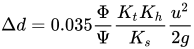
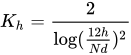











![{\displaystyle \Delta d=0.7{\frac {u^{2}}{2g}}=c_{iz}{\frac {\left[u(1+3r)\right]^{2}}{2g}}}](https://wikimedia.org/api/rest_v1/media/math/render/svg/81ca74ad46a4efb283f81c83b729233497187c5a)

![{\displaystyle \Delta d=0.47{\frac {\left[u(1+3r)\right]^{2}}{2g}}}](https://wikimedia.org/api/rest_v1/media/math/render/svg/03b7e0beb46b6ea5161ea0202162ada5b2624794)