JR Shikoku 2700 series
Diesel multiple unit train operated in Japan
From Wikipedia, the free encyclopedia
The 2700 series (2700系, 2700-kei) is a tilting diesel multiple unit (DMU) train type operated by Shikoku Railway Company (JR Shikoku) and Tosa Kuroshio Railway on limited express services in Shikoku, Japan.

| 2700 series | |
|---|---|
A 2700 series set in December 2021 | |
| Manufacturer | Kawasaki Heavy Industries |
| Replaced | 2000 series |
| Constructed | 2018–2020 |
| Entered service | 6 August 2019 |
| Number built | 41 cars (17 sets) |
| Formation | 2/3 cars |
| Capacity | 134 (3-car sets) 98 (2-car sets) |
| Operators | JR Shikoku Tosa Kuroshio Railway |
| Depots | Takamatsu, Kōchi |
| Specifications | |
| Car body construction | Stainless steel |
| Car length | 20,800 mm (68 ft 3 in)[1] |
| Width | 2,786 mm (9 ft 1.7 in)[1] |
| Height | 3,445 mm (11 ft 3.6 in)[1] |
| Floor height | 1,105 mm (3 ft 7.5 in) |
| Doors | 2 per side |
| Maximum speed | 130 km/h (81 mph) |
| Prime mover | SA6D140HE-2 diesel motor |
| Power output | 2 x 331 kW (445 hp) per car |
| Bogies | S-DT70 |
| Track gauge | 1,067 mm (3 ft 6 in) |
Design
The design is based on the 2600 series[2] and features a red, gold, and green color scheme, described as "Neo Japonism".[3]
Formation
2700 series sets consist of two[4] or three cars, and are formed as follows. There are 12 first class seats in the series 2800 cars.
Two-car sets[4]
| Designation | Mc | Mc' |
|---|---|---|
| Numbering | 2700 | 2750 |
| Capacity | 46 | 52 |
| Weight (t) | 46.8 | 46.9 |
Three-car sets
| Designation | Mc | Mc' | Msc |
|---|---|---|---|
| Numbering | 2700 | 2750 | 2800 |
| Capacity | 46 | 52 | 36 |
| Weight (t) | 46.8 | 46.9 | 47.4 |
Interior
The interior features reclining seats with power sockets, a wheelchair space and an accessible toilet.[3] LED lighting is used in order to reduce power consumption.[2]
Technical specifications
The trains have stainless-steel car bodies,[3] and are powered by two SA6D140HE-2 diesel motors.[4] Instead of the pneumatic-spring suspensions of the 2600 series, the 2700 series use pneumatic pendular suspensions, allowing active tilt up to 5°.[3]
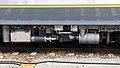 One of the underfloor SA6D140HE-2 diesel engines
 An S-DT70 bogie


History
40 cars were ordered from Kawasaki Heavy Industries as a replacement for ageing 2000 series Trans-Shikoku Express units.[3] The first set was unveiled on January 23, 2019.[4] Entry into revenue service was scheduled for the fall of 2019.[5] The trains entered service on August 6, 2019.[6][7] The 2700 series was the recipient of the 2020 Laurel Prize.[8]
