Jade Mirror of the Four Unknowns
From Wikipedia, the free encyclopedia


Jade Mirror of the Four Unknowns,[1] Siyuan yujian (simplified Chinese: 四元玉鉴; traditional Chinese: 四元玉鑒), also referred to as Jade Mirror of the Four Origins,[2] is a 1303 mathematical monograph by Yuan dynasty mathematician Zhu Shijie.[3]
The book consists of an introduction and three books, with a total of 288 problems. The first four problems in the introduction illustrate his method of the four unknowns. He showed how to convert a problem stated verbally into a system of polynomial equations (up to the 14th order), by using up to four unknowns: 天 Heaven, 地 Earth, 人 Man, 物 Matter, and then how to reduce the system to a single polynomial equation in one unknown by successive elimination of unknowns. He then solved the high-order equation by Southern Song dynasty mathematician Qin Jiushao's "Ling long kai fang" method published in Shùshū Jiǔzhāng (“Mathematical Treatise in Nine Sections”) in 1247 (more than 570 years before English mathematician William Horner's method using synthetic division). To do this, he makes use of the Pascal triangle, which he labels as the diagram of an ancient method first discovered by Jia Xian before 1050.
Zhu also solved square and cube roots problems by solving quadratic and cubic equations, and added to the understanding of series and progressions, classifying them according to the coefficients of the Pascal triangle. He also showed how to solve systems of linear equations by reducing the matrix of their coefficients to diagonal form.
Jade Mirror of the Four Unknowns consists of four books, with 24 classes and 288 problems, in which 232 problems deal with Tian yuan shu, 36 problems deal with variable of two variables, 13 problems of three variables, and 7 problems of four variables.
The Unitary Nebuls

The four quantities are x, y, z, w can be presented with the following diagram
 x
x
- y
 太w
太w
- z


The square of which is:


This section deals with Tian yuan shu or problems of one unknown.
- Question: Given the product of huangfan and zhi ji equals to 24 paces, and the sum of vertical and hypotenuse equals to 9 paces, what is the value of the base?
- Answer: 3 paces
- Set up unitary tian as the base( that is let the base be the unknown quantity x)
Since the product of huangfang and zhi ji = 24
in which
- huangfan is defined as:[4]
- zhi ji:


- therefore
- Further, the sum of vertical and hypotenuse is

- Set up the unknown unitary tian as the vertical


We obtain the following equation


 ()
()
- 太





Solve it and obtain x=3
The Mystery of Two Natures
 太 Unitary


equation: ;

from the given
- 太
equation: ;

we get:
- 太


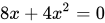
and
- 太
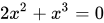
by method of elimination, we obtain a quadratic equation

solution: .

The Evolution of Three Talents
Template for solution of problem of three unknowns
Zhu Shijie explained the method of elimination in detail. His example has been quoted frequently in scientific literature.[5][6][7]
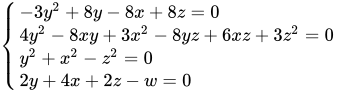
Set up three equations as follows
- 太
- .... I

- .....II

- 太
-
- ....III

Elimination of unknown between II and III
by manipulation of exchange of variables
We obtain
- 太
-
- ...IV

and
- 太
- .... V

Elimination of unknown between IV and V we obtain a 3rd order equation



Solve to this 3rd order equation to obtain ;

Change back the variables
We obtain the hypothenus =5 paces
Simultaneous of the Four Elements
This section deals with simultaneous equations of four unknowns.

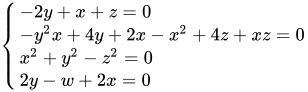
Successive elimination of unknowns to get




Solve this and obtain 14 paces
Book I

Problems of Right Angle Triangles and Rectangles
There are 18 problems in this section.
Problem 18
Obtain a tenth order polynomial equation:

The root of which is x = 3, multiply by 4, getting 12. That is the final answer.
Problems of Plane Figures
There are 18 problems in this section
Problems of Piece Goods
There are 9 problems in this section
Problems on Grain Storage
There are 6 problems in this section
Problems on Labour
There are 7 problems in this section
Problems of Equations for Fractional Roots
There are 13 problems in this section