January 26 (Eastern Orthodox liturgics)
Day in the Eastern Orthodox liturgical calendar
From Wikipedia, the free encyclopedia
January 25 - Eastern Orthodox liturgical calendar - January 27

All fixed commemorations below are observed on February 8 by Eastern Orthodox Churches on the Old Calendar.[note 1]
For January 26th, Orthodox Churches on the Old Calendar commemorate the Saints listed on January 13.
Saints
- Martyrs Ananias the priest, Peter the prison guard, and seven soldiers, in Phoenicia (295)[1][2][3]
- The Holy Two Martys of Phrygia[4][5]
- Venerable Ammon of Egypt (350), disciple of Saint Anthony the Great[1][6]
- Venerable Symeon "the Ancient" of Mount Sinai (c. 390)[1][7][8]
- Saint Paula of Rome (Paula of Palestine), monastic foundress in Palestine (404)[1][5][9][10][note 2][note 3]
- Venerable Gabriel, Abbot of the monastery of Saint Stephanos in Jerusalem (c. 490)[1][13]
- Venerable Xenophon and his wife Mary, and their two sons Saints Arcadius and John, of Constantinople (6th century)[1][14][15][16][note 4][note 5]
- Saint Theodore of Ajareli.[17]
Pre-Schism Western saints
- Saint Conon, Bishop and monastic founder on the Isle of Man (648)[1][11]
- Saint Theofrid (Theofroy), a monk at Luxeuil in France who became Abbot of Corbie, and a Bishop (c. 690)[11]
- Saint Athanasius, honoured as a bishop in Sorrento in the south of Italy[11]
- Saint Alphonsus of Astorga, Bishop of Astorga in Spain (9th century)[11][note 6]
- Saint Ansurius (Aduri, Asurius, Isauri), Bishop of Orense in Galicia (925)[11][note 7]
Post-Schism Orthodox saints
- Venerable Clement of Mt. Sagmation (1111)[1][18]
- Blessed David IV the Builder (the Restorer), King of Georgia (1125)[1][19][20]
- Venerable Xenophon, Abbot of Robeika, Novgorod (1262)[1][21][22]
- Venerable Arcadius of Vyaznikovsky (1592)[23][note 8]
- Saint Joseph Naniescu of Suceava, Metropolitan of Moldova, Romania (1902)[1][5][24][note 9]
New martyrs and confessors
Other commemorations
- Commemoration of the Great Earthquake at Constantinople (447-448), during the reign of Emperor Theodosius II (r. 408–450)[27][note 12]
- Translation of the relics (845) of Venerable Theodore the Confessor, Abbot of the Studion (826),[note 13] and his brother Saint Joseph the Confessor,[29][note 14] Archbishop of Thessalonica (832)[1][30][31]
- Repose of Metropolitan Gabriel of Novgorod and Saint Petersburg (1801)[1][32][note 15]
Icon gallery
 Venerable Xenophon and his wife Mary, and their two sons Sts. Arcadius and John
(Menologion of Basil II) David IV on 12th century icon at Saint Catherine's Monastery.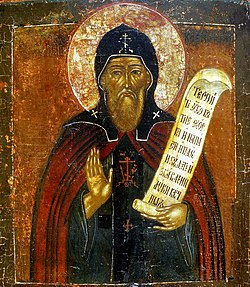
 Holy Hierarch Joseph the Merciful, the Metropolitan of Moldova.
 New Nun-martyr Matushka Maria (Lelyanova) of Gatchina.
 Metropolitan Gabriel of Novgorod and Saint Petersburg.
.jpg)


Notes
- The notation Old Style or (OS) is sometimes used to indicate a date in the Julian Calendar (which is used by churches on the "Old Calendar").
The notation New Style or (NS), indicates a date in the Revised Julian calendar (which is used by churches on the "New Calendar"). - A Roman lady of noble birth, she married a patrician and had five children, among them St. Eustochium and St. Blaesilla. Left a widow when she was thirty-two, she presided for twenty years over the sisterhood she had founded in Bethlehem. She also established a guest house for pilgrims there.[11]
- "At Bethlehem of Juda, the demise of St. Paula, widow, mother of St. Eustochium, virgin of Christ, who abandoned her worldly prospects, though she was descended from a noble line of senators, distributed her goods to the poor, and retired to the manger of our Lord, where, adorned with many virtues, and crowned with a long martyrdom, she departed for the kingdom of heaven. Her admirable life was written by St. Jerome."[12]
- Not to be confused with Venerable Xenophon (celebrated on April 24), † 1018, the builder of the Xenophontos monastery.
- Bishop of Astorga in Spain, he went to live as a simple monk at the monastery of St. Stephen de Ribas de Sil in Spanish Galicia.
- Bishop of Orense in Galicia, he helped found the monastery of Ribas de Sil in Spain. He became bishop in 915, but in 922 became a simple monk at the monastery. After his repose he was venerated there, together with seven other bishops who had followed his example.
- (in Russian) Прп. Аркадий Вязниковский (+1592). Also commemorated on the "Synaxis of the Saints of Vladimir" (Собор Владимирских святых), June 23.
- See: (in Russian) Мария Гатчинская. Википедии. (Russian Wikipedia).
- See: (in Russian) Попов, Иван Васильевич (богослов). Википедии. (Russian Wikipedia).
- Both the Constantinian and the original Theodosian walls were severely damaged, in two earthquakes, on 25 September 437 and on 6 November 447.[28] The latter was especially powerful, and destroyed large parts of the wall, including 57 towers. Subsequent earthquakes, including another major one in January 448, compounded the damage. Theodosius II ordered the praetorian prefect Constantine to supervise the repairs, made all the more urgent as the city was threatened by the presence of Attila the Hun in the Balkans.
- See: (in Russian) Гавриил (Петров). Википедии. (Russian Wikipedia).