January 5 (Eastern Orthodox liturgics)
Day in the Eastern Orthodox liturgical calendar
From Wikipedia, the free encyclopedia
January 4 - Eastern Orthodox liturgical calendar - January 6

All fixed commemorations below are observed on January 18 by Orthodox Churches on the Old Calendar.[note 1]
For January 5th, Orthodox Churches on the Old Calendar commemorate the Saints listed on December 23.
Feasts
- Eve of the Theophany of Our Lord and Saviour Jesus Christ[1][2]
Saints
- Prophet Micah (9th century BC)[1][3] (see also: August 14)
- Hieromartyr Theopemptus, Bishop of Nicomedia, and Martyr Theonas, former sorcerer (303)[1][4][5]
- Martyr Sais[6]
- Martyr Theoeidos[7]
- Venerable Syncletica (Synkletika, Syncletike), Nun of Alexandria (c. 350 or c. 460)[1][8][9]
- Righteous Domnina (Domna)[10]
- Righteous Tatiana, Nun[11]
- Saint Talida, Abbess at Antinoë, and her disciple Taora (5th century)
- Saint Apollinaria, Virgin of Egypt (c. 470)[1][12][13] (see also: January 4)
- Venerable Phosterius the Hermit (6th-7th century)[1][14][15]
- Venerable Menas of Sinai (6th century)[1][16]
- Venerable Gregory of Crete, Monk (c. 820)[1][17][18]
- Venerable Dorotheos the Younger, restorer of the ancient Monastery of the Holy Trinity at Chiliokomon in Amaseia, Pontus[19][note 2]
Pre-Schism Western saints
- Hieromartyr Telesphorus, a Greek who was Pope of Rome for ten years (c. 136)[21][note 3] (see also February 22, Eastern Orthodox)
- Saint Emiliana, a Roman lady and the paternal aunt of Saint Gregory the Great (6th century)[21][note 4]
- Saint Kiara (Chier), a spiritual daughter of Saint Fintan Munnu; she lived in Ireland near Nenagh in Co. Tipperary, at a place now called Kilkeary after her (c. 680)[21]
- Venerable Cera of Ireland (Ciar, Cyra, Cior, Ceara), Abbess (7th century)[21][note 5]
- Venerable Conwoïon (Convoyon), a Breton saint and Abbot (868)[21][note 6]
- Saint Gaudentius of Gnesen (Radim Gaudentius), first Archbishop of Gnesen in Poland (1004)[21][note 7]
Post-Schism Orthodox saints
- Venerable Symeon of the Pskov-Caves Monastery, Hieroschemamonk (1960)[1][22]
- Venerable Theophan, Schema-Archimandrite of Nizhyn and the Rykhlovsk Monastery (ru), Ukraine (1977)[1]
New martyrs and confessors
- New Venerable Martyr Romanus of Karpenisi (Carpenision) and Kapsokalyvia, at Constantinople (1694)[1][23][24] (see also February 16)
- New Hieromartyr Andrei (Andrew) Zimin, Archpriest, his wife Lydia, his mother-in-law Domnica, his two or three daughters, and his servant Maria, of Ussurisk, Siberia (1919 or 1920)[1][25][26]
- New Hieromartyr Joseph Bespalov, and with him 37 Martyrs (1921)[22][27][28]
- New Hieromartyr Stephen Ponomarev, Protopresbyter, at Alma-Ata (1933)[27]
- New Virgin Martyr Eugenia Domozhirova, at Alma-Ata (1933)[22][27][28]
- New Hieromartyr Sergius Lavrov, Priest (1934)[22][28]
- New Martyr Matthew Gusev (1938)[22][28]
Other commemorations
- Translation of the relics of Saint Rumon of Tavistock, Bishop, to Tavistock Abbey[22]
- Repose of Monk Alexander of Valaam Monastery (1810)[1]
Icon gallery
 Prophet Micah (18th-century icon)
 Martyrdom of Theopemptus, Bishop of Nicomedia and Theonas, former sorcerer (Menologion of Basil II, 10th century)
 Saint Syncletica of Alexandria (Menologion of Basil II, 10th century)
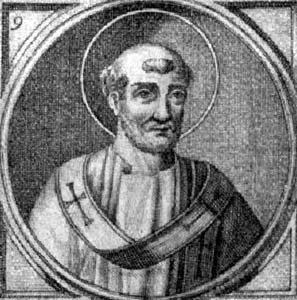 Hieromartyr Saint Telesphorus, Pope of Rome.

.jpg)
.jpg)

Notes
- The notation Old Style or (OS) is sometimes used to indicate a date in the Julian Calendar (which is used by churches on the "Old Calendar").
The notation New Style or (NS), indicates a date in the Revised Julian calendar (which is used by churches on the "New Calendar"). - "A homily, which is written in the form of a Vita by John Mauropous, metropolitan of Euchaita, on St. Dorotheos the Younger, gives the information that the monastery of Chryse Petra was not very far from Chiliokomon (the plain with a thousand towns, today Sulu-ova = the plain of the waters) where St. Dorotheos had restored the ancient monastery of Holy Trinity and had received the typikon of the monastery of Chryse Petra: ...καί της χρυσής καλούμενης πέτρας (ούδ' εκείνη δε πόρρω). This short reference reveals that the monastery of Chryse Petra was near Chiliokomon, and in a wider sense, near the Iris river."[20]
- "Born in Tipperary in Ireland, she was abbess of two convents, one at Kilkeary and the other at Tech Telle, now Tehelly."
- "Born in Brittany, he became a monk and founded the Monastery of St Saviour near Redon (Redon Abbey). He was driven out of his monastery by the Vikings and reposed in exile."
- "Younger brother of St. Adalbert of Prague and also a monk at the monastery of Sant' Alessio on the Aventine in Rome. He escaped the massacre in which his brother was martyred by the pagan Prussians and in 1000 became first Archbishop of Gnesen in Poland."