Jonathan Fisher (preacher)
From Wikipedia, the free encyclopedia


Parson Jonathan Fisher (1768–1847) was a Christian preacher in the US. He was the first Congregational minister from 1794 to 1837 in the village of Blue Hill, Maine, in the United States and helped found the Bangor Theological Seminary.
Jonathan Fisher was born in New Braintree, Massachusetts in 1768 as one of seven children born to Jonathan and Katherine Avery Fisher. He was raised in the home of his uncle a minister, after his father, a Revolutionary War soldier, had died.[1] As a young man he considered becoming a blacksmith, cabinet maker, or clockmaker.He went to Harvard University in 1788 where he studied liberal arts and divinity, supporting himself by waiting on other students in the dining hall and selling watercolors of wildlife. During this time he developed a shorthand or code in which his notes were kept.
Fisher later learned to paint with oils and make engravings, building his own press to strike prints. He created a natural history book written for children named "Scripture Animals", which depicted every creature named in the Bible.[2] He also illustrated several of his own books with his own paintings and engravings, as well as engraving a bookplate for the Blue Hill Library which is still used in the 21st century.
Fisher went to Blue Hill, Maine, in 1796 as the first settled pastor of the Congregational Church. In the same year, he married Dolly Battle.[1] Jonathan and Dolly had eight children, and Fisher remained at Blue Hill until his death.[3]
By November 2, 1797, Fisher had built his original house with the aid of his parishioners. The first house, which was in use for 100 years, was torn down by a Fisher descendant in 1896. It formed the shell of the present house which was begun in 1814, also built by Fisher.
Fisher played a central role in the Congregationalist Church where he administered the sacraments and admonished or excommunicated those who failed to abide by church doctrine.[4] Fisher constantly chided himself for his pleasure in "temporal" matters such as painting and mathematics, which he believed took away from his primary religious responsibilities both to himself and his congregation. Fisher read his Hebrew Bible at five o'clock each morning, and he practiced Hebrew, Latin, and Greek. Four or five young men boarded with his family as he instructed them in Latin and Greek.
Fisher was active in many fields of work to accumulate wealth. This included farming his own acres, concocting medical remedies, braiding straw hats, sawing out buttons from the bones of farm animals and dead household pets, repairing furniture, painting names on vessels or painting sleighs at $2.50 each, and crafting pumps, chairs, chests, hair-combs, tables, bureaus, bedsteads, cradles, and drumsticks for the local militia at 25 cents a pair.[5] He was the author of several books and poems.
Fisher participated in missionary journeys and was an active Trustee of the Bangor Theological Seminary. He supported the American Society for the Colonization of Liberia.
Mary Ellen Chase, JONATHAN FISHER: MAINE PARSON 1768 - 1847
Notebooks and journals
Throughout his life, Fisher kept a daily journal, and copies of all his letters. His notebooks and sketchbooks record his observations and interests in scientific matters, surveying, engineering, mathematics, geometry, agriculture, and natural history.
A journal digitised by the United States' National Oceanic and Atmospheric Administration describes Fisher's observations of sunspots during 1816-1817.[6][5]
 Mariner's Compass, 1791
 Garden Pea
 Descriptions of sunspots


Writings by Jonathan Fisher
- Scripture Animals, or Natural History of the Living Creatures Named in the Bible Written Especially for Youth Illustrated with Cuts. By Jonathan *Fisher, A.M. Portland, Published by William Hyde, (1834)
 Elephant
 Bitterns


Jonathan Fisher House
Jonathan Fisher's home in Blue Hill, Maine is open to the public seasonally. It is maintained and operated by The Jonathan Fisher Memorial, Inc., and was listed on the National Register of Historic Places[3] in 1969.
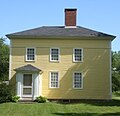 Front View
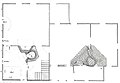 Fisher's Floorplan
 Parson Fisher's Study


Legacy
In 1908 several stained glass windows were installed in the church; one of these is a representation of the Angel with the Anchor, which was dedicated in memory of Rev. Fisher and his great-grandson Norman Fisher.[7]
In 1970, Fisher's parsonage was donated to the church by his descendant Ethelwyn Hinckley.

