Josiphos ligands
Family of chiral diphosphine ligands used for asymmetric catalysis
From Wikipedia, the free encyclopedia
A Josiphos ligand is a family of chiral diphosphine ligands that are used for asymmetric catalysis.[2][3] They feature a 1,2-disubstituted ferrocene backbone.

History

Modern enantioselective synthesis typically applies a well-chosen homogeneous catalyst for key steps. The ligands on these catalysts confer chirality. The Josiphos family of privileged ligands provides especially high yields in enantioselective synthesis.[4][5]
In the early 1990s, Antonio Togni began studying at the Ciba (now Novartis) Central Research Laboratories[6] previously-known[7] ferrocenyl ligands for a Au(I)-catalyzed aldol reaction.[6] Togni's team began considering diphosphine ligands, and technician Josi Puleo prepared the first ligands with secondary phosphines. The team applied Puleo's products in an Ru-catalyzed enamide hydrogenation synthesis; in a dramatic success, the reaction had e.e. >99% and a turnover frequency (TOF) 0.3 s−1.[6][7] The same ligand proved useful in production of (S)-metolachlor, active ingredient in the most common herbicide in the United States. Synthesis requires enantioselective hydrogenation of an imine; after introduction of the catalyst, the reaction proceeds with 100% conversion, turnover number (TON) >7mil, and turnover frequency >0.5 ms−1. This process is the largest-scale application of enantioselective hydrogenation, producing over 10 kilotons/year of the desired product with 79% e.e.[2] [1]
Josiphos ligands also serve in non-enantioselective reactions: a Pd-catalyzed reaction of aryl chlorides and aryl vinyl tosylates with TON of 20,000 or higher,[8] catalytic carbonylation,[9] or Grignard and Negishi couplings[10][11] A variety of Josiphos ligands are commercially available under licence from Solvias. The (R-S) and its enantiomer provide higher yields and enantioselectivities than the diastereomer (R,R).[1]
The consensus for the naming is abbreviating the individual ligand as (R)-(S)-R2PF-PR'2. The substituent on the Cp is written in front of the F and the R on the chiral center after the F.[2]
Reactions using Josiphos ligands
Some reactions that are accomplished using M-Josiphos complexes as catalyst are listed below. Other reactions where Josiphos ligands can be used are: hydrogenation of C=N, C=C and C=O bonds, catalyzed allylic substitution, hydrocarboxylation, Michael addition, allylic alkylation, Heck-type reactions, oxabicycle ring-opening, and allylamine isomerization.[citation needed]
- Hydroboration of styrene

- Conducted at -78 °C, the above reaction has e.e.'s up to 92% and TOF of 5-10 h−1.[12] Hayashi's Rh-binap complex gives better yield.[13]
- Hydroformylation of Styrene

- This reaction scheme yields of up to 78% ee of the (R) product, but low TON and TOF of 10-210 and 1-14h−1 (respectively).[2][14]
- Reductive amination
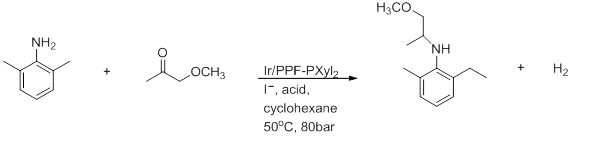
- Above is the preparation of (S)-metolachlor. Good yields and a 100% conversion crucially require AcOH solvent.[13]
- Hydrogenation of exocyclic methyl imine

- This key step to synthesize a HIV integrase inhibitor, Crixivan, is one of the few known homogeneous heteroarene hydrogenation reactions. Bulky R groups increase the catalyst's performance, with 97% e.e. and TON and TOF of 1k and 8 min−1, respectively.[15][16]
- Asymmetric synthesis of chromanoylpyridine derivatives
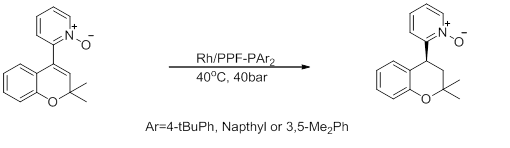
- This reaction, for an intermediate in synthesis of an antihypertensive and anti-alopecic chromanoylpyridine derivative, exhibits high enantioselectivity, but low activity.[17]


Modified Josiphos ligands
The ferrocene scaffold has proved to be versatile.[18][19][20]
Many variations of Josiphos ligands have been reported. One family is prepared from Ugi's amine.

An important improvement on initial syntheses has been using N(CH3)2 as a leaving group over acetate, although an acetic acid solvent gives better yields.[6]
Further reading
Clevenger, Andrew L.; Stolley, Ryan M.; Aderibigbe, Justis; Louie, Janis (2020). "Trends in the Usage of Bidentate Phosphines as Ligands in Nickel Catalysis". Chemical Reviews. 120 (13): 6124–6196. doi:10.1021/acs.chemrev.9b00682. PMID 32491839.