July 11 (Eastern Orthodox liturgics)
Day in the Eastern Orthodox liturgical calendar
From Wikipedia, the free encyclopedia
July 10 - Eastern Orthodox Church calendar - July 12

All fixed commemorations below are celebrated on July 24 by Old Calendar.[note 1]
For July 11th, Orthodox Churches on the Old Calendar commemorate the Saints listed on June 28.
Saints
- Hieromartyr Cindeus the Presbyter, of Pamphylia (283-305)[1][2][3][4][5][note 2]
- Martyr Marcian, by the sword.[3][7][8][9][note 3] (see also: July 13)
- Martyr Martyrocles, shot with arrows.[3][8][9][10]
- Martyrs Januarius and Pelagia, of Nicopolis in Armenia (c. 310)[1][11][note 4]
- Commemoration of the Miracle (451) of Great-martyr Euphemia the All-praised, of Chalcedon (304)[1][3][12][13][14][note 5] [note 6]
- Blessed Equal-to-the-Apostles Olga, Princess of Russia, named Helen in holy baptism (969)[1][3][16][17][note 7][note 8]
- Venerable Leo, monk, of Mandra (of the Sheepfold).[1][8][9][11][19]
- Saint Arsenius of Alexandria, martyred Patriarch of Alexandria (1010)[3][8][20][note 9]
Pre-Schism Western saints
- Saint Pius I, Pope of Rome from c.142 to c.155 (c. 155)[21][note 10][note 11]
- Saint Sidronius, a martyr in Rome under Aurelian (c. 270)[21][22][note 12]
- Saint Sabinus (Savinus) and Cyprian, two martyrs and brothers venerated in Brescia in Italy.[6][21]
- Saint Sabinus, a saint venerated near Poitiers in France, said to have been a disciple of St Germanus of Auxerre, confessor (5th century)[6][21]
- Saint Leontius II (the Younger), a soldier who served against the Visigoths, he became Bishop of Bordeaux and participated in the Council of Paris of 553 (c. 565)[21]
- Saint Drostan, founder and first Abbot of Old Deer in Aberdeenshire (c. 610)[1][9][11][21][23][24][note 13]
- Saint Amabilis (Mable), daughter of an English noble, she became a nun at Saint-Amand in Rouen in France (c. 634)[21]
- Saints Sigisbert and Placid, founders of Disentis Abbey (c. 650 or c. 750)[21][25][26][note 14]
- Saint John of Bergamo, Bishop of Bergamo, renowned for his learning and great success in fighting Arianism (c. 690)[21][note 15][note 16]
- Saint Hidulf (Hidulphus), founder of Moyenmoutier Abbey, and reputed Bishop of Trier (707)[21][27][28][note 17]
- Saint Abundius of Cordoba, Hieromartyr of Córdoba, Spain (854)[9][21][note 18][note 19]
- Saint Thurketyl (Turketil), the brother of King Edred of England, he became Abbot of Crowland and also of Bedford Abbey (975)[21][note 20]
Post-Schism Orthodox saints
- Venerable Nicodemus of Hilandar and Vatopedi, Mount Athos, instructor of St. Gregory Palamas (1320)[1][8][9][11][29]
- New Martyr Nicodemus of Elbasan and Mount Athos (1722)[1][3][8][11][30]
- New Monk-martyr Nectarius of St. Anne's Skete, Mount Athos, at Vryoulla, Ephesus (1820)[1][3][8][9][11][31]
- Venerbale Cyril the New, monk, of Paros (1833)[1][8]
New martyrs and confessors
- Momcilo Grgurevic, Dobroslav Blazenovic, Milan Bozic, Mihailo Djusic, Jovan Zecevic, Bozidar Jovic, Bogdan Lalic, Trifun Maksimovic, Velimir Mijatovic, Bozidar Minic, Miladin Minic, Marko Popovic, Dimitrije Rajanovic, Budimir Sokolovic, Relja Spahic, Lazar Culibrk, Savo Siljac, Savo Skaljka, Milorad Vukojicic, Ratomir Jankovic, Mihailo Jevdjevic, Dusan Prijovic, Dobrosav Sokovic, Nestor Trkulja, Serafim Dzaric, Andrija Siljak, Slobodan Siljak, and Jovan Rapajic.
- Venerable Archimandrite Sophrony (Sakharov) of Essex (1993)[32][33][note 21] (see also: June 28)
Other commemorations
- Translation of the relics of Venerable Benedict of Nursia, writer of the Rule of Saint Benedict (c. 547)[21][35][36][note 22][note 23] (see also: March 14 )
- Transfer of the Relics of Great-martyr Barbara to Kiev, by Barbara of Byzantium (d. 1125), third wife of Sviatopolk II of Kiev.[37]
- Icon of the Mother of God of Rzhevsk (1539)[11][38]
- Uncovering of the relics (1677) of Venerable Arkadius of Vyazemsk and Novotorzhsk (1077)[1][11][39][note 24]
- Uncovering of the relics (1998) of Hieromartyr Hilarion, Archbishop of Verey (1929)[1][11][40]
- Repose of cave-dweller Anastasia of St. Cornelius of Padan Hermitage, in Olonets (1901)[1]
Icon gallery
 Great-martyr Euphemia the All-praised, of Chalcedon.
 Blessed Equal-to-the-Apostles Olga, Princess of Russia, named Helen in holy baptism.
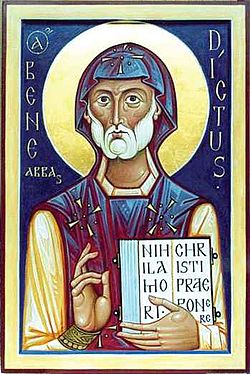 St. Benedict of Nursia.
 Hieromartyr Hilarion (Troitsky), Archbishop of Verey.
 Archimandrite Sophrony (Sakharov) of Essex.


.jpg)

Notes
- The notation Old Style or (OS) is sometimes used to indicate a date in the Julian Calendar (which is used by churches on the "Old Calendar").
The notation New Style or (NS), indicates a date in the Revised Julian calendar (which is used by churches on the "New Calendar"). - "At Nicopolis, in Armenia, the birthday of the holy martyrs Januarius and Pelagia, who for four days were racked, torn with iron claws and pieces of earthenware, and thus achieved their martyrdom."[6]
- Her feast day is on September 16. Name days celebrated today include:
- Euphemia (Îá½Ïημία).
- MAGNIFICATION:
"We magnify you, Holy Equal-to-the-Apostles, Great-Princess Ol'ha, who like a morning star first shone the light of the Orthodox Faith on our native land."
KONDAK, TONE 4:
"Today let us chant the praises of God, the Benefactor-of-All, Who has glorified Divinely-Wise Ol'ha in our land, that by her prayers He grant to our souls the forgiveness of sins."[18] - He is not recorded in the Synaxaristes. His memory is preserved in a manuscript of the Fonds Coislin.
- Pope from c 142 to c 155. He may have been a brother of Hermas, the writer of the work called The Shepherd. If so, Pius, like his brother, was born a slave. He opposed the Gnostics, notably the Gnostic Marcion. He may have been martyred.
- See: (in Italian) San Giovanni vescovo (Bergamo). Wikipedia. (Italian Wikipedia).
- Born in Regensburg in Germany, he became a monk at the monastery of Maximinus in Trier. Later he was consecrated bishop, but about the year 676 he founded the monastery of Moyenmoutier in the east of France and lived there. When he reposed he was Abbot both of Moyenmoutier and Bonmoutier (Galilaea, afterwards called Saint-Dié).
- A parish priest in Ananelos, a village near Cordoba in Spain. He had no thought of martyrdom, but when he had to, he bravely confessed Christ before the tribunal of the Moorish Caliph of Cordoba. He was beheaded and his body was thrown to the dogs.
- Of Danish origin, he restored the monastery of Crowland in England, which had been destroyed by the pagan Danes. He was also abbot of the monastery at Bedford.
- Here is the official statement from the Ecumenical Patriarchate on November 27, 2019:
- (in Greek) "ÎἰδικÏÏεÏον, ἡ á¼Î³Î¯Î± καί ἹεÏά ΣÏνοδοÏ, á¼ÏοδεÏθεá¿Ïα εἰÏήγηÏιν Ïá¿Ï Îανονικá¿Ï á¼ÏιÏÏοÏá¿Ï á¼Î½ÎγÏαÏεν Îµá¼°Ï ÏÏ á¼Î³Î¹Î¿Î»Ïγιον Ïá¿Ï á½ÏθοδÏÎ¾Î¿Ï á¼ÎºÎºÎ»Î·ÏÎ¯Î±Ï ÏοÏÏ á¼Î³Î½ÏÏμÎÎ½Î·Ï á½Ïιακá¿Ï βιοÏá¿Ï καί ÏολιÏÎµÎ¯Î±Ï á¼¹ÎµÏομÏναÏον ἹεÏÏÎ½Ï Î¼Î¿Î½ ΣιμÏνοÏεÏÏίÏην, ÎαθηγοÏμενον ÏÏημαÏίÏανÏα Ïá¿Ï á¼Î½ á¼Î³Î¯á¿³ á½Ïει ἹεÏá¾¶Ï ÎαÏιλικá¿Ï, ΠαÏÏιαÏÏικá¿Ï καί ΣÏÎ±Ï ÏοÏηγιακá¿Ï Îονá¿Ï ΣίμÏÎ½Î¿Ï Î ÎÏÏαÏ, καί á¼ÎºÎ¿Î»Î¿ÏθÏÏ ÎἰκονÏμον καί Î Î½ÎµÏ Î¼Î±ÏικÏν Ïοῦ ÎεÏοÏÎ¯Î¿Ï á¼Î½Î±Î»Î®ÏεÏÏ ÎÏÏÏÎ½Î¿Ï á¼ÏÏικá¿Ï, καί á¼ÏÏιμανδÏίÏην ΣÏÏÏÏνιον ΣαÏάÏÏÏ, ÎαθηγοÏμενον ÏÏημαÏίÏανÏα καί κÏίÏοÏα Ïá¿Ï á¼Î½ á¼ÏÏεξ á¼Î³Î³Î»Î¯Î±Ï ἹεÏá¾¶Ï Î Î±ÏÏιαÏÏικá¿Ï καί ΣÏÎ±Ï ÏοÏηγιακá¿Ï Îονá¿Ï Î¤Î¹Î¼Î¯Î¿Ï Î ÏοδÏÏÎ¼Î¿Ï ."[34]
- "Article X.âTranslation of St. Benedict's Relics. In the "Leabhar Breac" copy of the "Feilire," by St. Ãngus, there is a record of St. Benedict's festival, at the 11th of July. Furthermore, a scholion informs us, that he was Benedict, the Father of Monks. Usuard and other ancient Martyrologists have it as the festival for a Translation of his relics, as the Bollandists note at this day. They refer, however, to his chief feast, at the 21st of March for an exhaustive illustration of his Acts. Also, in Usuard is to be found, at this same date, a Translation of the relics of his sister Scholastica, whose chief festival and Acts are noticed, on the 10th of February."[36]
- Born near Nursia in Umbria in central Italy, at the age of twenty he went to live as a hermit in a cave near Subiaco. Many disciples flocked to him and he built a laura, composed of twelve small monasteries for them. About the year 530 he left Subiaco for Montecassino, where he founded a monastery and where he lived the rest of his life as a deacon and famed as a wonderworker. He reposed while standing in prayer before the altar. Some relics of St Benedict were later translated to France but others remained at Montecassino.
- His feast day in on December 13.