There are multiple equivalent definitions of the K-function.
The direct definition:
![{\displaystyle K(z)=(2\pi )^{-{\frac {z-1}{2}}}\exp \left[{\binom {z}{2}}+\int _{0}^{z-1}\ln \Gamma (t+1)\,dt\right].}](https://wikimedia.org/api/rest_v1/media/math/render/svg/92baaaf4dc396046aef97cda91dd4f102aa06973)
Definition via
![{\displaystyle K(z)=\exp {\bigl [}\zeta '(-1,z)-\zeta '(-1){\bigr ]}}](https://wikimedia.org/api/rest_v1/media/math/render/svg/12668025758db5c6b204ac5b1f43c1e8e05785a5)
where ζ′(z) denotes the derivative of the Riemann zeta function, ζ(a,z) denotes the Hurwitz zeta function and

Definition via polygamma function:[1]
![{\displaystyle K(z)=\exp \left[\psi ^{(-2)}(z)+{\frac {z^{2}-z}{2}}-{\frac {z}{2}}\ln 2\pi \right]}](https://wikimedia.org/api/rest_v1/media/math/render/svg/527eb0c1daf22e5bb0b92ff2ff331e64b68f597e)
Definition via balanced generalization of the polygamma function:[2]
![{\displaystyle K(z)=A\exp \left[\psi (-2,z)+{\frac {z^{2}-z}{2}}\right]}](https://wikimedia.org/api/rest_v1/media/math/render/svg/e7e5a0771140cd752c427198127287d5cc8b0466)
where A is the Glaisher constant.
It can be defined via unique characterization, similar to how the gamma function can be uniquely characterized by the Bohr-Mollerup Theorem:
Let  be a solution to the functional equation
  , such that there exists some
  , such that given any distinct
  , the divided difference
 ![{\displaystyle f[x_{0},x_{1},x_{2},x_{3}]\geq 0}](https://wikimedia.org/api/rest_v1/media/math/render/svg/8c0cd26e190d4f5b18250e540cf85b9a25d78d8d) .
Such functions are precisely
.
Such functions are precisely  , where
  is an arbitrary constant.[3]

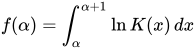

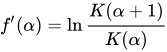
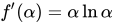

![{\displaystyle \int _{0}^{1}\ln K(x)\,dx=\lim _{t\rightarrow 0}\left[{\tfrac {1}{2}}t^{2}\left(\ln t-{\tfrac {1}{2}}\right)\right]+C\ =C}](https://wikimedia.org/api/rest_v1/media/math/render/svg/b8e8c9ffa5aadcb54c1d1df9e5a769e78d7fa08a)


