This phenomenon can be shown with a pentagram, which is a graph with 5 vertices and 5 edges. Each vertex can be colored either red or blue. An edge is said to match if both of its vertices have the same color. In a hidden variable model, the total number of mismatches over all of the edges has to be an even number due to cyclicity, i.e. 0, 2 or 4. Therefore, with a probability mixture over hidden variable assignments, the expectation value of the sum of mismatches over all of the 5 edges lies between 0 and 4.
A large number of KCBS pentagrams can be imagined, each with colorings hidden. On each pentagram, a theoretical observer uncovers 2 vertices that share a common edge. Doing this shows that no matter which edge is chosen, it always ends with finding blue-blue with a probability of  , red-blue with
  , and blue-red with . So, the expectation value of the sum of mismatches is
  .
.
To explain, each pentagram is a 3D quantum system with an orthonormal basis 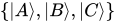 , and is initialized to
  . Each vertex is assigned a 1D projector projecting to
 ![{\displaystyle {\frac {1}{\sqrt {\sqrt {5}}}}|C\rangle +{\sqrt {1-{\frac {1}{\sqrt {5}}}}}\left[\cos \left({\frac {4\pi n}{5}}\right)|A\rangle +\sin \left({\frac {4\pi n}{5}}\right)|B\rangle \right]}](https://wikimedia.org/api/rest_v1/media/math/render/svg/0824b3bb2065ef0417885c478fc68544b030a9f0) , n = 0, ..., 4 .
, n = 0, ..., 4 .
Adjacent projectors commute. Projected vertices are colored red; otherwise, blue.
