Let  denote a height function of some probabilistic model with
 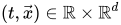 denoting space-time. So far only the case for
  , also noted as
  , was deeply studied, therefore we fix this dimension for the rest of the article. In the KPZ universality class exist two equilibrium points or fixed points, the trivial Edwards-Wilkinson (EW) fixed point and the non-trivial KPZ fixed point. The KPZ equation connects them together.
The KPZ fixed point is rather defined as a height function  and not as a particular model with a height function.
The KPZ fixed point 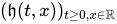 is a Markov process, such that the n-point distribution for
  and
and  can be represented as

where  and
and  is a trace class operator called the extended Brownian scattering operator and the subscript means that the process in
  starts.[1]
The KPZ conjecture conjectures that the height function of all models in the KPZ universality at time  fluctuate around the mean with an order of
  and the spacial correlation of the fluctuation is of order
  . This motivates the so-called 1:2:3 scaling which is the characteristic scaling for the KPZ fixed point. The EW fixed point has also a scaling the 1:2:4 scaling. The fixed points are invariant under their associated scaling.
The 1:2:3 scaling of a height function is for 

where 1:3 and 2:3 stand for the proportions of the exponents and  is just a constant.[2]
The strong conjecture says, that all models in the KPZ universality class converge under 1:2:3 scaling of the height function if their initial conditions also converge, i.e.

with initial condition

where  are constants depending on the model.[3]
If we remove the growth term in the KPZ equation, we get

which converges under the 1:2:4 scaling

to the EW fixed point. The weak conjecture says now, that the KPZ equation is the only Heteroclinic orbit between the KPZ and EW fixed point.
If one fixes the time dimension and looks at the limit

then one gets the Airy process  which also occurs in the theory of random matrices.[4]