Kamo Aquarium
Zoo in Yamagata, Japan
From Wikipedia, the free encyclopedia
Tsuruoka Municipal Kamo Aquarium (鶴岡市立加茂水族館, Kamo Suizokukan) is an aquarium located in Tsuruoka, Yamagata Prefecture, Japan. In 2005, it exceeded Monterey Bay Aquarium in California regarding the number of jellyfish display types and holds the Guinness World Records for this exhibition.[6]

1956 (second)
1972 (third)
1 June 2014 (current)
| Kamo Aquarium | |
|---|---|
| |
 The aquarium in 2018 | |
 Interactive map of Kamo Aquarium | |
| 38°45′42″N 139°43′29″E | |
| Date opened | 1930 (first) 1956 (second) 1972 (third) 1 June 2014 (current) |
| Location | Okuba 657-1, Imaizumi, Tsuruoka, Yamagata, Japan |
| No. of species | 140[1] |
| Annual visitors | 92,183 (1997)[2] 716,354 (2014) 497,738 (2018)[3] |
| Memberships | JAZA[4] |
| Major exhibits | the Worlds' largest[5] 60 jellyfish species |
| Website | kamo-kurage |
History

The facility was on the edge of bankruptcy again in the late 90's.[7][8][9] Until then, jellyfish exhibits at aquariums were extraordinary, and there was no breeding methods.[10] In addition, the Kamo does not have enough money.[11] In such a situation, the director Tatsuo Murakami groped to establish methods for breeding jellies,[12][13] it became the best jellyfish museum in the worlds. The popularity of the Vivarium exploded when Osamu Shimomura received the Nobel Prize in Chemistry in 2008, thanks to the studies he led on Aequorea victoria, a jelly that contains a green fluorescent protein, with two American scientists: Martin Chalfie of Columbia University and Roger Tsien of the University of California-San Diego.[14][15] He led his studies in Kamo, since at the time, it was the one of few marine museums displaying it.[16] Researchers from the world, including the Paris Aquarium Cineaqua in France, come to learn about this breeding and raising.[17][18]
With the light emission of the Aequorea victoria exhibited at the Kamo Aquarium Osamu Shimomura won the 2008 Nobel Prize in Chemistry. It was also reported that the Green Fluorescent Protein that was the reason for the award was derived from Aequorea victoria. This attracted attention to the museum, which breeds Aequorea victoria, and the number of visitors to the museum increased to 1.5 to 2 times the normal number. [9] The adult jellyfish bred in the museum emit light when they are collected from the natural world, but they do not emit light when the generations are changed by artificial propagation. Upon hearing this, Shimomura called the museum directly on October 24, 2008, and advised that "if you mix coelenterazine with food, it will shine in two weeks." Then, with the introduction of Shimomura, he took over coelenterazine from Katsunori Teranishi, a professor at the Graduate School of Bioresources, Mie University, and worked on a luminescence experiment.[19]
Northern elephant seal
A three-year-old 2.5-meter 273-kilogram female northern elephant seal[20] was found on Sanze beach (38°42′27.4″N 139°39′47.7″E), Tsuruoka on 16 October 2017.[21][22] She was weakened and injured[23] but recovered after receiving antibiotics at this Aquarium, growing to over 400-kilogram in March 2018.[24] She was named Naomi after a tennis player, Naomi Osaka by a public vote[25][26] and has been exhibited in a pool at Kamo.[27]
Exhibits
Fishes
Jellies
- Lion's mane jellyfish
- Immortal jellyfish
- Cyanea capillata Eschscholtz[28]
- Freshwater jellyfish[29]
- Habu-kurage[30]
- Glassy nautilus[31][32]
- Lychnorhiza lucerna[33]
- Acromitus maculosus[34][35]
- Jelly blubber[36]
- Egg-yolk jellyfish[37]
- Purple-striped jelly[38]
- Rhizostoma luteum[39][40]
- Blue jellyfish[41][42]
- Spotted jelly
- Mastigias papua etpisoni
- Atlantic sea nettle[43][44]
- Pacific sea nettle[45]
- Flame jellyfish[46]
- Beroe cucumis
- Cassiopea
- Bolinopsis mikado[47]
- Spirocodon saltator
- Clinging jellyfish
- Thimble jellyfish
- Pelagia (cnidarian)[48]
- South American sea nettle
- Pelagia noctiluca
Other sea creatures
Gallery

Jellyfish
 Kuranetarium Sign (a blendword combining kurage and planetarium)
 Shimmering Crystal jelly
 Flower hat jelly with fluorescent yellow and pink tentacles


 Glowing jellyfish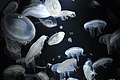

 Jellyfish farming, difficult to breed in captivity
 Growing baby jellyfish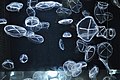



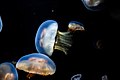




 Educational section with a large lecture hall and a special exhibition section for the growth and development of jellyfish


Other creatures


.jpg)


Restaurant jellyfish menu

- Jellyfish ramen[52] - contains ground cannonball jellyfish.
- Jellyfish sashimi
- Jellyfish icecream[53]
Access
- From JR Tsuruoka Station, 30 minutes by Shōnai Kōtsu bus bound for Yunohama Onsen, adjacent to Kamo Suizokukan stop.
