Kantishna, Alaska
From Wikipedia, the free encyclopedia
Kantishna, Alaska | |
|---|---|
 Kantishna | |
 | |
  Kantishna | |
| Coordinates: 63°31′31″N 150°57′29″W / 63.52528°N 150.95806°W | |
| Country | United States |
| State | Alaska |
| Borough | Denali |
| Government | |
| • Borough mayor | Christopher Noel[1] |
| • State senator | George Rauscher (R) |
| • State rep. | Kevin McCabe (R) |
| Elevation | 1,696 ft (517 m) |
| Time zone | UTC-9 (Alaska (AKST)) |
| • Summer (DST) | UTC-8 (AKDT) |
| ZIP codes | Kantishna is one of the sparsely-populated communities in Alaska that do not have a zip code. |
| GNIS feature ID | 1404435[2] |
Kantishna is an unincorporated community in Denali Borough, Alaska, United States, within Denali National Park and Preserve.[3] Founded as a gold mining camp in 1905, it endured longer than similar communities in the area, having been constructed nearest to the source of the gold. It lies in the Kantishna Hills at the junction of Eureka Creek and Moose Creek, 3 mi (5 km) northwest of Wonder Lake, and near the mouth of the Kantishna River. Although the community was once also called "Eureka", the Board on Geographic Names officially ruled in favor of "Kantishna" in 1944, the name given to the post office that was built at the site in 1905. Its elevation is 1,696 feet (517 m).[2]
There are several remote lodges in Kantishna. Guests may stay at the Denali Backcountry Lodge, Kantishna Roadhouse, or Camp Denali/North Face Lodge. The 92.5-mile (148.9 km) trip from the Denali Park Train Depot Archived March 21, 2012, at the Wayback Machine to the lodges, via lodge buses, takes more than six hours.[4] Private vehicles are not permitted to enter the interior of Denali National Park.
Kantishna Air Taxi service provides chartered flights to Kantishna Airport.
Geology
Several thousand prospectors came to the Kantishna Hills region after placer gold was discovered in the summer of 1905 along Glacier Creek by Joe Quigley and Jack Horn. Almost simultaneously, Joe Dalton and his partner Stiles found gold along Friday Creek and staked a claim on July 12. Claims on Eureka Creek soon followed as did mining towns. These included Glacier on Bearpaw River, Diamond on Moose Creek, plus Roosevelt and Square Deal on McKinley River. By 1906 the towns of Roosevelt, Square Deal and Diamond were mainly deserted. In 1916, the population of the region was 35, half of whom were men working claims.[5][6]
The placer gold originates from the Birch Creek schist, which is cut by quartz veins bearing gold, silver, and antimony in the form of stibnite. This schist is the oldest formation in the region and is bordered on the south by the Tonzona Group composed of black slates and argillites, and the Tatina Group composed on black slates, argillites, greywackes, and interbedded limestones and cherts.[5]
Mining ceased in 1985, after the district was incorporated into the national park.[7]: 79
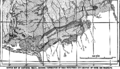 Kantishna Region geological map
 Kantishna Region geological map legend
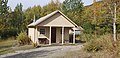 Fannie Quigley home
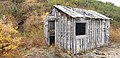 Little Annie Mine


