Kasamori-ji
From Wikipedia, the free encyclopedia
| Kasamori-ji | |
|---|---|
笠森寺 | |
 Kasamori-ji Kannon-dō | |
| Religion | |
| Affiliation | Buddhist |
| Deity | Jūichimen Kannon Bosatsu |
| Rite | Tendai |
| Status | functional |
| Location | |
| Location | 302 Kasamori, Chōnan-machi, Chōsei-gun, Chiba-ken |
| Country |  Japan Japan |
  Shown within Chiba Prefecture  Kasamori-ji (Japan) | |
| Coordinates | 35°23′58.6″N 140°11′56.1″E / 35.399611°N 140.198917°E |
| Architecture | |
| Founder | c. Saichō |
| Completed | c.784 |
| Website | |
| Official website | |
 | |
Kasamori-ji (笠森寺) is a Buddhist temple located in the town of Chōnan, Chiba Prefecture, Japan.[1] It belongs to the Tendai sect and its honzon is a hibutsu statue of Jūichimen Kannon Bosatsu shown to the public in the years of the Ox and Horse in the 12-year cycle of the Chinese zodiac. The temple's full name is Daihi-zan Nankō-in Kasamori-ji (大悲山 楠光院 笠森寺).The temple is the 31st stop on the Bandō Sanjūsankasho pilgrimage route.[2] The temple is also called "Kasamori-dera" using the alternate pronunciation of the Chinese character for temple (tera). It is located within the borders of the Kasamori Tsurumai Prefectural Natural Park.
The foundation of this temple is uncertain. According to the temple's legend, the Tendai monk Saichō (767–822) visited the area in 784 and carved a statue of the Jūichimen Kannon Bosatsu, and on a sacred camphor tree and enshrined it in small chapel. Nichiren is said to have frequently prayed at Kasamori-ji, and an image of him in his quarters at the temple exists.[3] Kasamori-ji appears in both an ukiyo-e woodblock print by Hiroshige II (1829–1869) as part of the series One Hundred Views of the Provinces.[4] Additionally, Matsuo Bashō (1644–1694) wrote a haiku about the temple.[5] A marker with the haiku is located in front of the temple gate.[6]
The temple is 11.7 kilometers west (approximately 23 minutes by car) from Mobara Station on the JR East Sotobō Line, or 6.9 kilometers east of Kazusa-Ushiku Station on the Kominato Railway Kominato Line.
 Kannon-dō
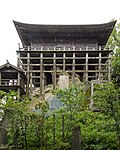 Kannon-dō
 Ukiyoe by Hiroshige


