Keoti Fort
Fort in India
From Wikipedia, the free encyclopedia
Keoti Fort (also Keonti Fort) is an Indian fortress (qila) situated on the Rewa Plateau about 53 kilometres (33 mi) north-east of the city of Rewa, in Rewa district in the Indian state of Madhya Pradesh.

| Keoti Fort | |
|---|---|
Part of Madhya Pradesh,  India India | |
| Rewa District, Madhya Pradesh, India | |
 Keoti Fort, front and south side, ca. 2024 | |
| Site information | |
| Type | Fort |
Open to the public | yes |
| Condition | dilapidated |
| Location | |
  Keoti Fort Keoti fort within Madhya Pradesh | |
| Coordinates | 24.81714°N 81.45725°E |
History
Keoti Fort is said to have been constructed by Raja Parmal Dev in 1500 AD, who was a Baghel Rajput King and son of Maharaja of Rewa (princely state)[1] mentioned in an account of the Indian Rebellion of 1857. Thakur Ranmat Singh Baghel was a descendent of Kothi Royal Family of Kothi State, a Baghel Rajput sardar (commander) in the army of Maharaja Raghuraj Singh of Rewa (princely state) and later a prominent leader in the Rebellion in Rewa State during 1857 revolt in Baghelkhand, went into hiding in Keoti Fort. In a battle at the Keoti Fort, he killed the British officer who came to arrest him, thereby defeating the British authorities.
The Maharaja Raghuraj Singh of Rewa wanted Ranmat Singh to surrender to the British authorities with the assurance that he would not be killed. However his Diwan Dinbandhu Pandey of Rewa acted as an informant for the British, which led to the capture of Ranmat Singh by the British authorities. He was hanged in 1860 for the murder of the British officers along with his active role in 1857 revolt against the British authorities in Baghelkhand where he defeated the British authorities in multiple battles across areas like Nagod, Bhilsain, Chitrakoot, Nowgong, and Keoti.[2][3]
During the Revolt of 1857 in Baghelkhand, the Kothi State (Kothi princely state, Satna) is noted for helping Thakur Ranmat Singh Baghel. Historical accounts mention that Raja Bahadur Avdhoot Singh Baghel of Kothi State provided rebels with shelter, ammunition, food, money, and support for recruiting fighters.
Geography
Keoti Fort is situated on the Rewa Plateau near the northern end of the Vindhya Escarpment.[4] The fort is built on the right bank of a ravine that the Mahana River has cut into the escarpment. The 98 m (322 ft) high Keoti Falls is on the opposite side of the ravine, visible from the northern part of the fort. The elevation of Keoti Fort is 280 m (920 ft) above mean sea level.[citation needed]
Keoti Fort is about 53 km (33 mi) from the city of Rewa.[5] The nearest airport is located at Prayagraj (Allahabad) in Uttar Pradesh, a distance of 114 km (71 mi).[6]
Architecture


The west wall of the fort runs along the Mahana ravine for about 200 m (660 ft). The south wall extends about 100 m (330 ft) east from the ravine. The east wall with the main entrance is about 40 m (130 ft) long. There after, the fort depth narrows to about 25 m (82 ft) at the northern end of the fort. The total area enclosed by the walls is about 1.0 ha (2.5 acres). Towers are located at the corners of the outer walls.[citation needed]
The construction material is stone and clay mortar. Loopholes with three angles of fire are built into the outer walls at regular intervals and at various heights. These are useful for defense against enemy coming across the flat plateau.[citation needed]
Tourism

The fort is open to the public. Entrance is free (January 2024).[citation needed] Fairs are held annually which attract many people. The carvings and stone artefacts, the natural beauty and the view of the Keoti Falls across the gorge behind the fort are attractions that draw visitors.[1]
Controversies
In 2016, the MP Government denotified the fort as a "protected heritage site" and transferred it to the Madhya Pradesh Tourism Board to be developed as a heritage hotel. In July 2021, the MP Tourism Board issued a tender for development of the Keoti Fort.[7] However, it was reported that the fort had not been leased out and was falling into a state of disrepair.[8] A local news report claims that the fort is being neglected by the administration and is frequented by petty criminals. These factors may deter tourists.[1]
Popular culture
The Hindi movie Bindhi aur Bandook (1972) was shot at Keoti Fort.[1]
Gallery
Exterior views
 Front (east) facade
 Front and north side
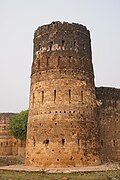 Tower on south-east corner
 Gorge of the Mahana River behind the fort


Interior views
 Inside south-west part, tower overlooking the ravine, loopholes near the top of the wall
 Northern inside of the fort: ravine on left, north wall in centre, east wall on right
 Loophole in outer wall for firearms
 Grinding stone inside the fort


