Khotiv hillfort
From Wikipedia, the free encyclopedia
Ukrainian: Хотівське городище | |
 Southern view of Khotiv and Khotiv hillfort | |
  Location of the hillfort on a map of Kyiv | |
| Location | Khotiv, Obukhiv Raion, Kyiv Oblast, Ukraine |
|---|---|
| Coordinates | 50°20′01″N 30°29′16″E / 50.33361°N 30.48778°E |
| Type | hillfort |
| Length | 1,000 m (3,300 ft) |
| Width | 700 m (2,300 ft) |
| Area | 31 ha (77 acres) inside the main rampart |
| History | |
| Founded | 7-6 century BC |
| Abandoned | 6-5 century BC or later |
| Periods | early Iron Age |
| Cultures | Scythian |
| Site notes | |
| Excavation dates | 1948, 1965-1967, 2004, 2016 |
| Condition | partially ruined |
| Ownership | partially private |
| Public access | Yes |
| Official name | Городище (Hillfort) |
| Type | Archaeology |
| Reference no. | 100013-Н |

_People_01_(YDS_9876).jpg)
Khotiv hillfort is a hillfort of early Iron Age (Scythian times, 6 century BC) in the village of Khotiv, Ukraine.
The hillfort adjoins the southern part of Kyiv, namely Feofaniya Park. It occupies a rhombic plateau 1000x700 m wide, bordered by valleys of the streams. All the plateau area, 31 ha, was surrounded with earth rampart, while the slope of the hill was fortified by a scarp with a berm and a moat beneath.[1] The rampart, scarp and berm are well preserved on the western and eastern edges, and remains of the moat are much less conspicuous now. It is supposed that the hillfort had 3 entrances: in the northern, eastern and southern part of the rampart.[2]
Khotiv hillfort has the status of an archaeological monument since 1965.[3] In 2007, official borders of the monument were cut down, and in 2009, the excluded areas became the place of house building. The northern part of the hillfort was demolished by building of a palace of Ukrainian billionaire Yuri Kosiuk.[4][5] Later, the works began in the southern and eastern parts of the hillfort, which are planned for building too.[6]
The first scientific mention of the hillfort was made in 1848 by Ivan Fundukley, governor of Kyiv and notable historian. He mentions a local legend about some town which existed there.[7] In 1864, the hillfort was briefly described by another student of local history, Lavrentiy Pohilevich. He reports this legend in more details: in ancient times there was a town with a castle of a prince named Siriak.[8] The locality around the hillfort is still named Siriakove, and the first recording of this name dates from 1465.[9]
In 1873, Volodymyr Antonovych made more detailed description and drawing of the hillfort. He interpreted it as Zvenigorod, the fortress of Kievan Rus' known from chronicles.[10] But archaeological data of 20th century refuted this idea.
In 1917, a bronze Corinthian coin of 5 century BC was found on the hillfort during a botanical excursion. In 1918, fragments of Scythian pottery and some Slavic things dated from 8-10 centuries AD were found there.[9]
The first archaeological exploration of the hillfort was conducted in 1948 by the team from Institute of Archaeology in Kyiv headed by Ye. F. Pokrovska. They excavated 156 m2 in the northern projection of the hillfort.[2] Next expedition, headed by Ye. O. Pokrovska from the same Institute, worked in 1965-1967 and unearthed 508 m2 in the vicinity.[11][1]
In 2004, northern and western parts of the hillfort (6.75 ha) were explored with micromagnetic measurements. It revealed location of several ancient buildings, some of which were unearthed.[12] Some additional measurements were made in 2009.[5]
In 2016, new excavations were made on the western side of the hillfort, on the rampart.[13]
 Khotiv hillfort (captioned as "Гора Городище" - "Mount Hillfort") on the map by General Staff of the Russian army, 1842.
 Sketch of the Khotiv hillfort made by Volodymyr Antonovych in 1870s.


Finds
Like other hillforts of Scythian times, Khotiv hillfort had buildings only near the inner side of the rampart. The central area was empty and could be used for farming or for keeping of cattle, maybe during wars.[14] Discovered structures include dugouts and surface buildings with walls made of wood covered by clay. Fallen walls of several such buildings were excavated, some of them exceed 20 m in length.[5] Some buildings had stoves. Another notable object is an oval 1x1.5 m wide, paved with stones bearing marking of fire.[15]
The pottery from the hillfort include local and Greek one. The latter was identified as originating from Chios, Lesbos, Klazomenai and Samos.[16] Other ceramic finds from the hillfort include spindle whorls of various forms, a sinker, and small balls and "loafs" which can be votive offerings.[17]
A broken stone dish and a fragment of a stone axe or hammer, sling stones, sharpening stone with a hole, bone handle of an unknown tool, beads made of lead and yellow glass, as well as other things were also unearthed.
Bronze finds include a snake-like ring, pins, including nail-like ones, and arrowheads of various forms. Iron objects include knives, awls, pin and some arrowheads.[1][12]
Another notable find is a bone plate with a carving of a panther or a leopard in the Scythian animal style. Size of the plate is 4.7x1.8 cm. It could be a part of a bigger thing, e.g. a spoon or a mirror handle. Associated ceramics and arrowheads indicate that it belongs to the end of 6th century BC. Such carvings are rare on Scythian bone things, although more common on metallic ones.[14]
Plenty of animal bones imply that dwellers of the hillfort bred domestic animals, predominantly horses. Pigs, cows, sheep, goats and dogs were also held.[14] Dominance of horses differs Khotiv hillfort from other hillforts of forest steppe, which were dominated by cattle or pigs.[2] Its inhabitants hunted wild boars, deers, elks, bears and beavers, sometimes aurochs and hares. Sporadic bones of turtles, foxes, geese, ducks, crows and men were found.[14][2]
Finds from the hillfort date from Scythian times, approximately 6, or, according to other researchers, 6 to 5 century BC.[5][14] It was probably founded by people called Scythians-tillers by Herodotus. They were not Scythians in the strict sense, but they stayed under Scythian dominion and partially adopted their culture.[18]
Founders of the hillfort were nonmigratory. They practised agriculture and animal breeding, especially horse breeding. Hunting played a big role. Trade with Ancient Greek colonies was less intensive than on other hillforts of forest steppe. It is explained by larger distance.[2][11]
- Finds from the Khotiv hillfort
 Pottery
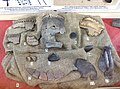 Pottery
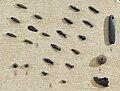 Bronze and iron arrowheads, lead bead, sharpening stone, ceramic spindle whorl etc.
 Beast on a bone plate
 Bronze nail-like pins


