KiHa 261 series
Japanese train type
From Wikipedia, the free encyclopedia
The KiHa 261 series (キハ261系) is a tilting diesel multiple unit (DMU) train type operated by Hokkaido Railway Company (JR Hokkaido) on limited express services in Hokkaido, Japan, since 2000.[1]

| KiHa 261 series | |
|---|---|
KiHa 261 series on a Sōya service in June 2022 | |
| In service | 2000–Present |
| Manufacturers | |
| Replaced | KiHa 183 series, KiHa 281 series, KiHa 283 series |
| Constructed | 1998– |
| Number under construction | 28 vehicles (as of December 2013[update]) |
| Number built | 35 vehicles (as of April 2013[update]) |
| Number in service | 35 vehicles (as of April 2013[update]) |
| Formation | 4–6 cars per trainset |
| Operator | JR Hokkaido |
| Depot | Naebo |
| Specifications | |
| Car body construction | Stainless steel |
| Car length |
|
| Width |
|
| Height |
|
| Doors | 1 per side |
| Maximum speed | 130 km/h (81 mph) |
| Prime mover | N-DMF13HZH (× 1 or × 2 per car) |
| Power output | 460 hp (340 kW) per engine |
| Transmission | Hydraulic |
| Track gauge | 1,067 mm (3 ft 6 in) |
Design
The running gear was based on the KiHa 201 series trains introduced in 1997, and the body design was a joint venture with the Danish State Railways (DSB).[2]
Fleet
As of 1 April 2013[update], 35 KiHa 261 series vehicles were in operation.[3] 14 were built by Fuji Heavy Industries, and 21 were built by JR Hokkaido.[3] A further 28 vehicles are on order to be delivered from fiscal 2015.[4]
Operations
KiHa 261 series trainsets are used on the following services.[1]
KiHa 261-0 series
KiHa 261-1000 series
Formations
Sōya
Sōya services are normally formed of four-car KiHa 261-100 series sets, and are sometimes lengthened to six cars during busy periods.[5]
4-car formations
Four-car sets are formed as follows.[5]
| Car No. | 1 | 2 | 3 | 4 |
|---|---|---|---|---|
| Numbering | KiRoHa 261-200 | KiHa 260-200 | KiHa 260-100 | KiHa 261-100 |
6-car formations
Six-car sets are formed by adding two cars as shown below. Car 1 (and car 21) includes Green (first) class and standard class accommodation.[5]
| Car No. | 1 | 2 | 3 | 4 | 5 | 6 | |
|---|---|---|---|---|---|---|---|
| Numbering | KiRoHa 261-200 | KiHa 260-200 | KiHa 260-100 | KiHa 261-100 | KiHa 260-100 | KiHa 261-100 |
| Car No. | 21 | 22 | 1 | 2 | 3 | 4 | |
|---|---|---|---|---|---|---|---|
| Numbering | KiRoHa 261-200 | KiHa 260-200 | KiRoHa 261-200 | KiHa 260-200 | KiHa 260-100 | KiHa 261-100 |
Super Tokachi

Super Tokachi services were originally formed of five-car KiHa 261-1000 series sets, but these were later reduced to four cars.[1]
The 4-car Super Tokachi sets are formed as follows.
| Car No. | 1 | 2 | 3 | 4 |
|---|---|---|---|---|
| Numbering | KiRo 261-1100 | KiHa 260-1100 | KiHa 260-1200 | KiHa 261-1200 |
Interior
 Interior of Green car KiRo 261-1102 in April 2009
 Interior of ordinary-class car KiHa 260-1102 in April 2009


History

A four-car pre-production set was delivered from Fuji Heavy Industries in November 1998 for evaluation and testing.[1][2] The first production trains were introduced on Super Sōya services between Sapporo and Wakkanai from the start of the revised timetable on 11 March 2000.[1]
New KiHa 261-1000 series 5-car sets were introduced on Super Tokachi services between Sapporo and Obihiro from October 2007.[1]

A further 28 KiHa 261 series vehicles were delivered from 2015 onward, and these are not equipped with tilting capability.[4]
From December 2015 until the end of 2017, the KiHa 261-1000 series fleet were gradually repainted into a new livery with white front ends, yellow front-end gangway doors, and a purple bodyside stripe.[6]
KiHa 261-5000 series
On 17 October 2019, JR Hokkaido announced plans to introduce two new KiHa 261-5000 series 5-car sets.[7] They each feature external liveries inspired by the hamanasu and lavender flowers, which, according to JR Hokkaido, are prominent throughout Hokkaido.[8]
Car 1 is designated as a lounge car, featuring window-facing seats and transverse seating bays with tables. Cars 2 through 5 are ordinary-class cars, featuring 2+2 abreast seating throughout.[9]
The "Hamanasu" set was built at Kawasaki Heavy Industries' Hyogo factory, and was delivered to JR Hokkaido in July 2020.[10] It entered revenue service on 17 October of that year.[11] The "Lavender" set was delivered from the same factory in January 2021[12] and entered revenue service in May of that year,[13] although it was originally intended to enter service in April.[8]
 The KiHa 261-5000 series "Hamanasu" set in May 2022
 The KiHa 261-5000 series "Lavender" set in June 2022
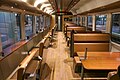 Lounge interior
 Ordinary-class interior


