Kintetsu 16600 series
Electric multiple unit train type operated in Japan by Kintetsu
From Wikipedia, the free encyclopedia
The Kintetsu 16600 series "Ace" (è¿é16600ç³»ãAceã) is a limited express electric multiple unit (EMU) train type operated by Kintetsu Railway in Japan since 19 June 2010.[1]
.jpg)
| Kintetsu 16600 series "Ace" | |
|---|---|
A 16600 series 2-car set in the new Kintetsu limited express train livery in September 2017 | |
| Manufacturer | Kinki Sharyo |
| Family name | Ace |
| Replaced | 16000 series |
| Constructed | 2010â |
| Entered service | 19 June 2010 |
| Number built | 4 vehicles (2 sets) |
| Number in service | 4 vehicles (2 sets) |
| Formation | 2 cars per trainset |
| Fleet numbers | YT01 â YT02 |
| Operator | Kintetsu Railway |
| Depot | Furuichi |
| Lines served | |
| Specifications | |
| Car body construction | Steel |
| Car length | 20,800 mm (68 ft 3 in) (motor cars) 20,500 mm (67 ft 3 in) (trailers) |
| Width | 2,800 mm (9 ft 2 in) |
| Height | 4,150 mm (13 ft 7 in) (motor cars) 4,135 mm (13 ft 6.8 in) (trailers) |
| Doors | Two plug doors per side |
| Maximum speed | 110 km/h (70 mph) |
| Traction system | 2-level PWM variable-frequency (IGBT) |
| Acceleration | 2.5 km/(hâ s) (1.6 mph/s) |
| Deceleration | 4.0 km/(hâ s) (2.5 mph/s) |
| Electric system | 1,500 V DC, overhead line |
| Current collection | Pantograph |
| Bogies | Bolsterless KD-316 (motor cars) KD-316A (trailers) |
| Braking system | Electronically controlled pneumatic brakes |
| Safety system | Kintetsu ATS (old/new) |
| Multiple working | 16000/16010/16400 series |
| Track gauge | 1,067 mm (3 ft 6 in) |
Operations
They are operated on the Minami Osaka and Yoshino Lines, replacing the earlier 16000 series trains.[1]
Design
The design is based on the Kintetsu 22600 series trains used on the standard gauge Osaka and Nara Lines since 2009.[1]
Formation
As of 1 April 2016[update], two two-car sets are in operation, formed as follows, with one motored ("Mc") car and one non-powered trailer ("Tc") car.[2]
| Car No. | 1 | 2 |
|---|---|---|
| Designation | Tc | Mc |
| Numbering | 1670x | 1660x |
Car 2 has two single-arm pantographs.[2]
Interior
Car 1 has a wheelchair space and toilet. Car 2 has a smoking compartment.[2]
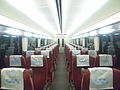 Interior view


