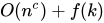
Niedermeier (1998) cites the example of vertex cover, with its natural parameter (the number of vertices in the cover). At that time the best known parameterized time bound had  . Solving
  gives a klam value of approximately 129. However,
the
gives a klam value of approximately 129. However,
the  part of the time bound can be simplified out of it, giving a bound of the form
  with both a larger constant factor hidden in the O-notation and a larger base of the exponent hidden in its approximate decimal value.
For a simple exponential bound
with both a larger constant factor hidden in the O-notation and a larger base of the exponent hidden in its approximate decimal value.
For a simple exponential bound  such as this one, one can solve directly
 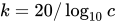 from which Niedermeier derives a klam value of approximately 165. Subsequent research has developed parameterized vertex cover algorithms with
  [4] giving a klam value of approximately 190. That is, one can conclude from this analysis that vertex cover instances with cover size greater than 190 are out of reach of this algorithm, but instances whose cover size is sufficiently far below this limit are likely to be solvable.
Another example of a problem in which the klam value has been explicitly used as a goal for future research is the maximum leaf spanning tree problem, in which the goal is to find a spanning tree of a graph with as many leaf nodes as possible (parameterized by the number of leaves). Fellows et al. (2000) develop an algorithm for this problem which they compare using the klam value to previous work on the same problem: previous algorithms had klam values of 1 and 5, and theirs has a klam value of 16.[5] However, they also suggest that it should be possible to provide improved algorithms for this problem with a klam value of at least 50. Although this remains open, several later papers have incrementally improved the klam value of this problem to 37.[6]