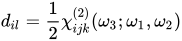
Assuming an instantaneous response we can consider the second order polarisation to be given by  for
for  the applied field onto a nonlinear medium.
For a lossless medium with spatial indices  we already have full permutation symmetry, where the spatial indices and frequencies are permuted simultaneously according to

In the regime where all frequencies  for resonance
  then this response must be independent of the applied frequencies, i.e. the susceptibility should be dispersionless, and so we can permute the spatial indices without also permuting the frequency arguments:

This is the Kleinman symmetry condition.