Koenigs function
From Wikipedia, the free encyclopedia
In mathematics, the Koenigs function is a function arising in complex analysis and dynamical systems. Introduced in 1884 by the French mathematician Gabriel Koenigs, it gives a canonical representation as dilations of a univalent holomorphic mapping, or a semigroup of mappings, of the unit disk in the complex numbers into itself.
Proof
Let D be the unit disk in the complex numbers. Let f be a holomorphic function mapping D into itself, fixing the point 0, with f not identically 0 and f not an automorphism of D, i.e. a Möbius transformation defined by a matrix in SU(1,1).
By the Denjoy-Wolff theorem, f leaves invariant each disk |z | < r and the iterates of f converge uniformly on compacta to 0: in fact for 0 < r < 1,

for |z | ≤ r with M(r ) < 1. Moreover f '(0) = λ with 0 < |λ| < 1.
Koenigs (1884) proved that there is a unique holomorphic function h defined on D, called the Koenigs function, such that h(0) = 0, h '(0) = 1 and Schröder's equation is satisfied,

The function h is the uniform limit on compacta of the normalized iterates, .

Moreover, if f is univalent, so is h.[1][2]
As a consequence, when f (and hence h) are univalent, D can be identified with the open domain U = h(D). Under this conformal identification, the mapping f becomes multiplication by λ, a dilation on U.
- Uniqueness. If k is another solution then, by analyticity, it suffices to show that k = h near 0. Let
- near 0. Thus H(0) =0, H'(0)=1 and, for |z | small,
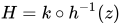

- Substituting into the power series for H, it follows that H(z) = z near 0. Hence h = k near 0.
- Existence. If then by the Schwarz lemma


- On the other hand,
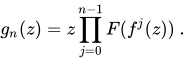
- Hence gn converges uniformly for |z| ≤ r by the Weierstrass M-test since

- Univalence. By Hurwitz's theorem, since each gn is univalent and normalized, i.e. fixes 0 and has derivative 1 there, their limit h is also univalent.
Koenigs function of a semigroup
Let ft (z) be a semigroup of holomorphic univalent mappings of D into itself fixing 0 defined for t ∈ [0, ∞) such that
- is not an automorphism for s > 0
- is jointly continuous in t and z




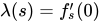
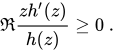
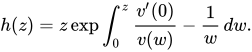
Each fs with s > 0 has the same Koenigs function, cf. iterated function. In fact, if h is the Koenigs function of f = f1, then h(fs(z)) satisfies Schroeder's equation and hence is proportion to h.
Taking derivatives gives

Hence h is the Koenigs function of fs.