Korail Class 200000
South Korean train
From Wikipedia, the free encyclopedia
The Korail Class 200000 or TEC (Trunk-line Electric Car) is a type of electric multiple unit operated by Korail for the Nuriro services.

| Korail Class 200000 | |
|---|---|
 Korail Class 200000 with revised livery in 2023 | |
| In service | 1 June 2009 - present |
| Manufacturer | Hitachi Rail |
| Family name | A-train |
| Constructed | 2006–2008 |
| Entered service | 2009 |
| Number built | 32 carriages (8 sets) |
| Number in service | 28 carriages (7 sets)[1] |
| Number scrapped | 4 carriages (1 set; accident damage) (Set 2003) |
| Formation | 4 cars per trainset Mc1-Tp-T-Mc2 |
| Fleet numbers | 2001–2008 |
| Capacity | 263 passengers[1] |
| Operator | Korail |
| Lines served | |
| Specifications | |
| Car body construction | Aluminium |
| Train length | 94.0 m (308 ft 5 in)[1] |
| Car length | 23.08 m (75 ft 9 in)[1] |
| Width | 3.18 m (10 ft 5 in)[1] |
| Height | 3.75 m (12 ft 4 in) |
| Maximum speed |
|
| Weight | 171 t (168 long tons; 188 short tons)[1] |
| Axle load | 12 t (12 long tons; 13 short tons) |
| Traction system | 2-level IGBT–VVVF (Hitachi) |
| Traction motors | 8 × 250 kW 3-phase AC induction motor (Hitachi) |
| Power output | 2,000 kW (2,682 hp)[1] |
| Deceleration | from 150 to 0 km/h (93 to 0 mph) in 900 m (0.6 mi)[1] |
| Electric system | 25 kV 60 Hz AC (nominal) from overhead catenary |
| Current collection | Pantograph |
| Bogies | Hitachi KH-221 monolink-type bolsterless bogies with yaw dampers |
| Braking systems | Regenerative, electrical and pneumatic |
| Safety systems | ATP, ATS |
| Coupling system | Shibata |
| Track gauge | 1,435 mm (4 ft 8+1⁄2 in) standard gauge |
History
It was originally scheduled to deliver units in the summer of 2008 and start operation on 15 December of the same year with the extension of Line 1 of the Seoul Metropolitan Subway. Due to the 2008 financial crisis, the amount of foreign currency delivery more than doubled from the time of contract. The first train was delivered on 9 January 2009, and the trial operation began on 6 February. On 1 June 2009, the trains entered regular service .[2]
Gallery
 On test in 2009
 Trainsets being forwarded by locomotive in 2009
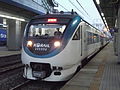 Running Nuriro services on Chungbuk Line in 2013
 Front design in 2020
 Pantograph
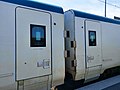 Doors with old livery
 The trainsets were made by Hitachi Rail
 Train interior in 2021


.jpg)


.jpg)
.jpg)
