Kreiss matrix theorem
From Wikipedia, the free encyclopedia
In matrix analysis, Kreiss matrix theorem relates the so-called Kreiss constant of a matrix with the power iterates of this matrix. It was originally introduced by Heinz-Otto Kreiss to analyze the stability of finite difference methods for partial difference equations.[1][2]
Properties
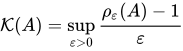
Given a matrix A, the Kreiss constant 𝒦(A) (with respect to the closed unit circle) of A is defined as[3]

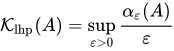
while the Kreiss constant 𝒦lhp(A) with respect to the left-half plane is given by[3]

- For any matrix A, one has that 𝒦(A) ≥ 1 and 𝒦lhp(A) ≥ 1. In particular, 𝒦(A) (resp. 𝒦lhp(A)) are finite only if the matrix A is Schur stable (resp. Hurwitz stable).
- Kreiss constant can be interpreted as a measure of normality of a matrix.[4] In particular, for normal matrices A with spectral radius less than 1, one has that 𝒦(A) = 1. Similarly, for normal matrices A that are Hurwitz stable, 𝒦lhp(A) = 1.
- 𝒦(A) and 𝒦lhp(A) have alternative definitions through the pseudospectrum Λε(A):[5]
- , where pε(A) = max{|λ| : λ ∈ Λε(A)},
- , where αε(A) = max{Re|λ| : λ ∈ Λε(A)}.
- 𝒦lhp(A) can be computed through robust control methods.[6]