LIAZ 100 series
From Wikipedia, the free encyclopedia
- Czech Republic: Jablonec nad Nisou and Mnichovo Hradiště
- Slovakia: Zvolen (LIAZ 06 plant)
- Bulgaria: Shumen (Madara)
| LIAZ 100 series | |
|---|---|
 LIAZ 110.051 + LIAZ 150.261 | |
| Overview | |
| Manufacturer | LIAZ |
| Production | 1974 - 1994 |
| Assembly |
|
| Body and chassis | |
| Class | Truck |
| Body style | COE Cab forward |
| Powertrain | |
| Engine | Diesel naturally aspirated or turbocharged I6 1974 - 1994 |
| Transmission | Praga 9 - speed manual ZF 16 - speed manual |
| Chronology | |
| Predecessor | LIAZ MT |
| Successor | LIAZ 200 series |
| LIAZ MŠ 634 | |
|---|---|
| Overview | |
| Manufacturer | LIAZ |
| Layout | |
| Configuration | I6 |
| Combustion | |
| Fuel type | Diesel fuel |
| Cooling system | Water-cooled |
| Output | |
| Power output | 148 kW (198 hp) - 224 kW (300 hp) |
| Torque output | 900 N⋅m (660 ft⋅lbf) |
| Dimensions | |
| Dry weight | ~ 900 kg (1,984 lb) |
LIAZ 100 series is a collective term for several modifications of truck made by LIAZ company in Czechoslovakia, later Czech Republic in town Jablonec nad Nisou between 1974 and 1994.
In LIAZ started the development of a new series already in the 60s, but due to problems with the supply was made just upgraded a number of LIAZ RT and LIAZ MT. Originally intended transient model, which should produce only temporary, eventually to be replaced by LIAZ 100 and in 1974. Versions with special cabin were labeled number 110th
New LIAZ have compared to 706 RT completely new engine, transmission, cab and axle meets the requirements of customers and time. Development effort thwarted complications with suppliers and so was in 1969 Transitional Council MT with new engines and axles.
Since 1974, gradually started the production of trucks 100.45, 100.05 flatbed and other variants of vehicles from 100 series. The first trucks were obliquely motor M series with a volume of 11 940 cm³ and a power of 210, in 1978 was refurbished and known as M1 and in 1988 was again modernized to M2. New units reached thanks to turbo power up to 236 kW (320 hp), and longevity to overhaul 420,000 km. New and were 9 and 10-point synchronized gearbox Praga. Modernization in 1984 brought tilting cab and air suspension front and rear axles.
Produce began Tippers 150 (4×2) and 151 (4×4) chassis 111 (4×4) and 122 (6×2) for the superstructure. Other enhancements to Series 100 has received since 1989, when the market opens increased competition. In the menu, so there was a new 16-speed gearbox ZF, remote cabin with high roof MAXI braking system ABS, central lubrication, electric mirrors and windows, cooling box or ISRI seats.
Production Series 100/110 was terminated after 20 years of production in 1994, but according to customer orders were implemented until the end of the company's existence.
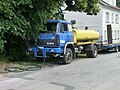 LIAZ 110 as tank
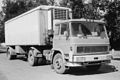 LIAZ 100.42, tractor with Orličan semitrailer
 LIAZ 151.261, tipper
 LIAZ 110, tractor unit
 LIAZ 111.840, garbage truck
 Special version LIAZ 101.860, which has cab unified with Karosa 700 series

.jpg)


.jpg)
Historical cars
- Private collector car (reg. No. 5273, ex DP Brno)
Configuration
Serial
- 4x2 - two axles, steerable front, rear driven
- 4x4 - two axles, front steer, both powered by engine
- 6x2.2 - three axles, steerable front, middle-powered, rear retractable
- 6x2.4 - three axles, front and middle steerable, powered rear
Prototypes and specials
- 6x4 - three axles, steerable front, middle and rear driven
6x4 AGRO - driven front and middle axle. The rear axle is retractable.
Cabins
- Middle non folding - original series cab 100
- Short non folding - created small-scale series of secondary contraction cabins
- Middle folding - first modernization mid cabin
- Short folding - cab for daily use
- Middle modernized - the second modernization mid cabin
- maxi - High cab for the long haul
- long - multi crew (up to 9 seats)


