Lagrangian Grassmannian
Type of vector space in mathematics
From Wikipedia, the free encyclopedia
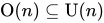
In mathematics, the Lagrangian Grassmannian is the smooth manifold of Lagrangian subspaces of a real symplectic vector space V. Its dimension is 1/2n(n + 1) (where the dimension of V is 2n). It may be identified with the homogeneous space
- U(n)/O(n),
where U(n) is the unitary group and O(n) the orthogonal group. Following Vladimir Arnold it is denoted by Λ(n). The Lagrangian Grassmannian is a submanifold of the ordinary Grassmannian of V.
A complex Lagrangian Grassmannian is the complex homogeneous manifold of Lagrangian subspaces of a complex symplectic vector space V of dimension 2n. It may be identified with the homogeneous space of complex dimension 1/2n(n + 1)
- Sp(n)/U(n),
where Sp(n) is the compact symplectic group.
As a homogeneous space
To see that the Lagrangian Grassmannian Λ(n) can be identified with U(n)/O(n), note that is a 2n-dimensional real vector space, with the imaginary part of its usual inner product making it into a symplectic vector space. The Lagrangian subspaces of are then the real subspaces of real dimension n on which the imaginary part of the inner product vanishes. An example is . The unitary group U(n) acts transitively on the set of these subspaces, and the stabilizer of is the orthogonal group . It follows from the theory of homogeneous spaces that Λ(n) is isomorphic to U(n)/O(n) as a homogeneous space of U(n).


It is a compact manifold of dimension . It is a (real, nonsingular) projective algebraic variety. Given a Lagrangian subspace A, the set of Lagranigian subspaces complementary to A is affine. Given an arbitrary complementary subspace B, this affine space consists of the graphs of symmetric linear operators , . This is an affine space of dimension since the dimensions of A and B are both n. Symmetry here means that the form is a symmetric form on B. Likewise, the tangent space at a lagrangian subspace A is the space of symmetric opeators .


From the fibration the fundamental group may be inferred from the long exact homotopy sequence:


Topology
The stable topology of the Lagrangian Grassmannian and complex Lagrangian Grassmannian is completely understood, as these spaces appear in the Bott periodicity theorem: , and – they are thus exactly the homotopy groups of the stable orthogonal group, up to a shift in indexing (dimension).


In particular, the fundamental group of is infinite cyclic. Its first homology group is therefore also infinite cyclic, as is its first cohomology group, with a distinguished generator given by the square of the determinant of a unitary matrix, as a mapping to the unit circle. Arnold showed that this leads to a description of the Maslov index, introduced by V. P. Maslov.

For a Lagrangian submanifold M of V, in fact, there is a mapping

which classifies its tangent space at each point (cf. Gauss map). The Maslov index is the pullback via this mapping, in

of the distinguished generator of
- .

Maslov index
Given a fixed Lagrangian subspace in the Lagrangian Grassmannian , the subset is the Maslov cycle, a singular hypersurface in .[1] For a generic path of Lagrangian subspaces in whose endpoints are transverse to , the Maslov index is the signed intersection number of the path with .[2] The Maslov index is invariant under homotopies of paths through Lagrangian subspaces, provided the endpoints remain transverse to the chosen reference Lagrangian . For a loop, it depends only on the homotopy class of the loop and is independent of the choice of .[1][2]


The Maslov index is important in the study of caustics and semiclassical asymptotics. Roughly speaking, when a family of Lagrangian subspaces crosses the Maslov cycle, one encounters a caustic relative to the chosen reference Lagrangian ; in the theory of Fourier integral operators and the WKB approximation, such crossings produce phase corrections governed by the Maslov index.[3][4]