Lampang province
Province of Thailand
From Wikipedia, the free encyclopedia
Lampang (Thai: ลำปาง, pronounced [lām.pāːŋ]; Northern Thai: ᩃᩣᩴᨻᩣ᩠ᨦ) is one of Thailand's seventy-six provinces (changwat), situated in upper northern Thailand. The old name of Lampang was Khelang Nakhon.

Lampang
ลำปาง ᩃᩣᩴᨻᩣ᩠ᨦ | |
|---|---|
| จังหวัดลำปาง · ᨧᩢ᩠ᨦᩉ᩠ᩅᩢᨯᩃᩣᩴᨻᩣ᩠ᨦ | |
From left to right, top to bottom : Wat Phra That Lampang Luang, Chae Son National Park, Wat Sri Chum, Wat Phra Kaeo Don Tao, Wang River, The Thai Elephant Conservation Center | |
 Flag  Seal | |
| Nicknames: Khelang Nakhon (Thai: เขลางค์นคร) Kukuta Nakhon (white rooster city) Mueang Rot Ma (horse carriage city) | |
| Motto: ถ่านหินลือชา รถม้าลือลั่น เครื่องปั้นลือนาม งามพระธาตุลือไกล ฝึกช้างใช้ลือโลก ("Well-known coal. Renowned horse carriages. Celebrated pottery. The renowned beauty of Phra That (Lampang Luang). Internationally famed elephant training.") | |
 Map of Thailand highlighting Lampang province | |
| Country | Thailand |
| Capital | Lampang |
| Government | |
| • Governor | Chutidej Meechan (since 2024) |
| • PAO Chief Executive | Tuangrat Lohasunthon |
| Area | |
• Total | 12,488 km2 (4,822 sq mi) |
| • Rank | 9th |
| Population (2024)[2] | |
• Total |  704,126 704,126 |
| • Rank | 37th |
| • Density | 56/km2 (150/sq mi) |
| • Rank | 70th |
| Human Achievement Index | |
| • HAI (2022) | 0.6390 "average" Ranked 42nd |
| GDP | |
| • Total | baht 68 billion (US$2.3 billion) (2019) |
| Time zone | UTC+7 (ICT) |
| Postal code | 52xxx |
| Calling code | 054 |
| ISO 3166 code | TH-52 |
| Vehicle registration | ลำปาง |
| Website | lampang |

.jpg)


| Lampang province | |
|---|---|
 | |
| Thai name | |
| Thai | ลำปาง |
| RTGS | Lampang |
| Northern Thai name | |
| Northern Thai | ᩃᩣᩴᨻᩣ᩠ᨦ (Lam phuang) |

Geography
Lampang is in the broad river valley of the Wang River, surrounded by mountains. In Mae Mo district lignite is found and mined in open pits. To the north of the province is the 1,697-metre (5,568 ft) high Doi Luang.
Within the province are Chae Son and Doi Khun Tan National Parks in the Khun Tan Range, as well as Tham Pha Thai, Doi Luang National Park, and the Huai Tak Teak Biosphere Reserve in the Phi Pan Nam Range.[5] The total forest area is 8,747 km2 (3,377 sq mi) or 70 percent of provincial area.[1]
National parks
There are nine national parks, of which six are in region 13 (Lampang branch), Doi Luang in region 15 (Chiang Rai), Wiang Kosai in region 13 (Phrae) and Si Satchanalai in region 14 (Tak), they are the protected areas in Lampang province.[6] (Visitors in fiscal year 2024)[7]
| Tham Pha Thai National Park | 1,200 km2 (460 sq mi) | (19,778) |
| Doi Luang National Park | 1,169 km2 (451 sq mi) | (29,179) |
| Mae Wa National Park | 582 km2 (225 sq mi) | (4,432) |
| Wiang Kosai National Park | 410 km2 (160 sq mi) | (16,616) |
| Doi Chong National Park | 336 km2 (130 sq mi) | (1.310) |
| Chae Son National Park | 297 km2 (115 sq mi) | (171,423) |
| Doi Khun Tan National Park | 255 km2 (98 sq mi) | (19,775) |
| Si Satchanalai National Park | 213 km2 (82 sq mi) | (13,617) |
| Khelang Banphot National Park | 80 km2 (31 sq mi) | (4,183) |
Wildlife sanctuaries
There are two wildlife sanctuaries, Doi Pha Muang in region 13 (Lampang branch) and Tham Chao Ram in region 14 (Tak), they are the protected areas in Lampang province.
| Doi Pha Muang Wildlife Sanctuary | 687 km2 (265 sq mi) |
| Tham Chao Ram Wildlife Sanctuary | 341 km2 (132 sq mi) |
Location protected areas
| Overview protected areas of Lampang | ||||||||||||||||||||||||||

|
History
Starting in the 7th century Lampang was part of the Dvaravati period Hariphunchai Kingdom of the Mon. But it was King Mengrai of Lanna who incorporated the complete Haripunchai Kingdom into his kingdom in 1292. Lampang or Nakhon Lampang or Lakhon, was under Burmese rule after the fall of Lanna Kingdom from the 16th century to 18th century. During the uprising against Burmese rule by Siam's new kings in the late-18th century, a local Lampang leader became Siam's ally. After the victory, the leader, Kawila, was named the ruler of Chiang Mai, the former center of Lanna, while his relative ruled Lampang. The city continues to be one of the important economic and political centers in the north. Lampang became a province of Thailand in 1892.[8]
Transport
The city is an important highway hub, with a four lane highway link to Chiang Mai and Chiang Rai, as well as a major highway to Phrae and the eastern Lanna provinces. Lampang is roughly a 1.5 hour bus ride to Chiang Mai. Lampang is a stop for the Chiang Mai-bound train, approximately 10 hours from Bangkok.
Lampang Airport is served by Bangkok Airways (three flights daily to Suvarnabhumi Airport) and Nok air (four flights daily to Don Mueang) (Oct 2015).
Health
The main hospital of Lampang is Lampang Hospital, operated by the Ministry of Public Health.
Tourism
Lampang province is not visited by many tourists, only about 900,000 per year, most of them passing through. In early 2019, the provincial governor rolled out a program called "Lampang: Dream Destination" to raise the number of visitors to two million within two years.[9]
Economy

Lampang is known for the production of ceramic goods and its mining operations. A great deal of ball clay, china stone, and lignite are extracted from the surrounding mountains. There are more than 200 ceramic factories in and around Mueang Lampang District. Most are small- to medium-sized operations producing novelties (plant pots, dolls), tableware, and building materials (tiles, railings). The largest coal fired power plant in Southeast Asia[10] is in Mae Mo District near the lignite mining area. The plant uses lignite as fuel. The largest concrete plant is also north of Mueang Lampang. This is also powered by lignite. Limestone is another abundant rock mined in Lampang. Agriculturally, the province produces rice and pineapples.
Symbols
The provincial seal shows a white rooster inside the entrance to the Phra That Lampang Luang Temple. According to local legend, Buddha visited the province. The god Indra worried that the people would not wake up by themselves to show respect to Buddha, and therefore woke them by transforming himself into a white rooster.
The provincial flower is the Heliconia (Heliconia sp.), and the provincial tree is the Indian Elm (Holoptelea integrifolia). According to the legend, this tree was planted in the temple during Buddha's visit. The provincial aquatic life is the horseface locah (Acantopsis dialuzona).
Administrative divisions

Provincial government
The province is divided into 13 districts (amphoes). These are further divided into 100 subdistricts (tambons) and 855 villages (mubans).
Local government
As of 26 November 2019 there are:[11] one Lampang Provincial Administration Organisation (ongkan borihan suan changwat) and 42 municipal (thesaban) areas in the province. Lampang has city (thesaban nakhon) status. Khelang Nakhon, Lom Raet and Phichai have town (thesaban mueang) status. Further 38 subdistrict municipalities (thesaban tambon). The non-municipal areas are administered by 60 Subdistrict Administrative Organisations - SAO (ongkan borihan suan tambon).
Human achievement index 2022
| Health | Education | Employment | Income |
 |
 |
 |
 |
| 76 | 28 | 60 | 43 |
| Housing | Family | Transport | Participation |
 |
 |
 |
.png) |
| 22 | 58 | 54 | 3 |
| Province Lampang, with an HAI 2022 value of 0.6390 is "average", occupies place 42 in the ranking. | |||
Since 2003, United Nations Development Programme (UNDP) in Thailand has tracked progress on human development at sub-national level using the Human achievement index (HAI), a composite index covering all the eight key areas of human development. National Economic and Social Development Board (NESDB) has taken over this task since 2017.[3]
| Rank | Classification |
| 1 - 13 | "high" |
| 14 - 29 | "somewhat high" |
| 30 - 45 | "average" |
| 46 - 61 | "somewhat low" |
| 62 - 77 | "low" |
| Map with provinces and HAI 2022 rankings |
 |
Gallery

 Singha Lanna
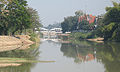 Wang River
 Phra That Lampang Luang
 Burmese-style Wat Srichum
 Hot springs at Chae Son National Park


