Landau derivative
From Wikipedia, the free encyclopedia
In gas dynamics, the Landau derivative or fundamental derivative of gas dynamics, named after Lev Landau who introduced it in 1942,[1][2] refers to a dimensionless physical quantity characterizing the curvature of the isentrope drawn on the specific volume versus pressure plane. Specifically, the Landau derivative is a second derivative of specific volume with respect to pressure. The derivative is denoted commonly using the symbol or and is defined by[3][4][5]


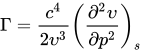
where
- is the sound speed,
- is the specific volume,
- is the density,
- is the pressure, and
- is the specific entropy.


Alternate representations of include
![{\displaystyle {\begin{aligned}\Gamma &={\frac {\upsilon ^{3}}{2c^{2}}}\left({\frac {\partial ^{2}p}{\partial \upsilon ^{2}}}\right)_{s}={\frac {1}{c}}\left({\frac {\partial \rho c}{\partial \rho }}\right)_{s}=1+{\frac {c}{\upsilon }}\left({\frac {\partial c}{\partial p}}\right)_{s}\\[2ex]&=1+{\frac {c}{\upsilon }}\left({\frac {\partial c}{\partial p}}\right)_{T}+{\frac {cT}{\upsilon c_{p}}}\left({\frac {\partial \upsilon }{\partial T}}\right)_{p}\left({\frac {\partial c}{\partial T}}\right)_{p}.\end{aligned}}}](https://wikimedia.org/api/rest_v1/media/math/render/svg/c1475296254099c8416cf94718ad4649a0b4ecfd)
For most common gases, , whereas abnormal substances such as the BZT fluids exhibit . In an isentropic process, the sound speed increases with pressure when ; this is the case for ideal gases. Specifically for polytropic gases (ideal gas with constant specific heats), the Landau derivative is a constant and given by


where is the specific heat ratio. Some non-ideal gases falls in the range , for which the sound speed decreases with pressure during an isentropic transformation.


